Four months after telecommunications rivals Bell Canada and Rogers Communications closed their $1.3 billion acquisition of Maple Leaf Sports and Entertainment, Tom Anselmi is blunt about what must change.
“The mandate is to win,” said Anselmi, president and chief operating officer of MLSE, sitting in a conference room inside the company’s sleek 15th floor headquarters overlooking Lake Ontario in downtown Toronto. “[MLSE] has been a great business. Now, we have to be a great sports organization as well.”
 |
MLSE’s holdings include the Raptors, Maple Leafs and Toronto FC, but that’s only the start.
Photo by: GETTY IMAGES (3); MLSE / PHOTO ILLUSTRATION BY COREY M. EDWARDS
|
Indeed, MLSE’s size speaks to its success. When the company’s planned sale was announced in December 2011 — a deal that would move the company from the Ontario Teachers’ Pension Plan to a powerhouse partnership between Bell and Rogers, Canada’s largest media companies and two bitter rivals — MLSE’s myriad properties had an enterprise value of more than $2 billion. But the deal registered hardly a tremor in the United States despite the scale of the transaction.
Think AEG or Madison Square Garden Sports in structure, and two national media rivals teaming to buy it.
MLSE may be the most powerful sports and entertainment property in North America that operates in relative anonymity, at least south of the Canadian border.
“They are a big part of the North American sports landscape and are one of the most profitable [sports and entertainment companies],” said Brian Cooper, president and CEO of Toronto-based sports marketer S&E Sponsorship Group and a former MLSE vice president of operations and development. “They just don’t have the profile of an AEG, but they have done a good job in building the business. While they are in one of the top five markets in North America, the company just doesn’t get the play it should.”
A futile level of team performance certainly hasn’t helped.
The Maple Leafs, an Original Six NHL franchise, are the crown jewel of the MLSE stable. On the back of one of the league’s most passionate fan bases along with the league’s highest ticket prices, Toronto is one the NHL’s most valued franchises. It also hasn’t been in the postseason since 2004, the longest playoff drought in the NHL. The Leafs last won the Stanley Cup in 1967.
Similarly, MLSE’s NBA franchise, the Raptors, have been absent from the playoffs since 2008. And Toronto FC, coming off its worst season since MLSE bought into the MLS in 2007, has never made the playoffs.
“MLSE is one of the few combined hockey and basketball team and arena joint ownerships, and it is in a major market in Canada,” said Marc Ganis, president of Chicago-based sports consultancy SportsCorp Ltd., “but it gets less attention because it is in Canada and its teams have been very poor. Its hockey team is arguably the most relevant in the NHL, but its performance has been abysmal compared to the interest in it — [and the Raptors] have had very little relevance, especially for a team that plays in the Eastern time zone.”
Reversing that win-loss record is about to become that much more important now that the ownership of the teams’ parent company is looking at the clubs as media content programming.
“Rogers and Bell provide a great resource and a base that we love to have,” said MLSE Chairman Larry Tanenbaum. “Their breadth and scope in Canada fits in so well. We are in this for the long play. The mindset is, how to take this $2 billion business to a $4 billion business. I feel there is a lot of upside. They are buying an overall business that has grown out of sports content.”
A Deep Reach
What the records of the Maple Leafs, Raptors and Toronto FC have not hurt is MLSE’s financial clout. That’s due in large part to how much MLSE controls beyond those three franchises.
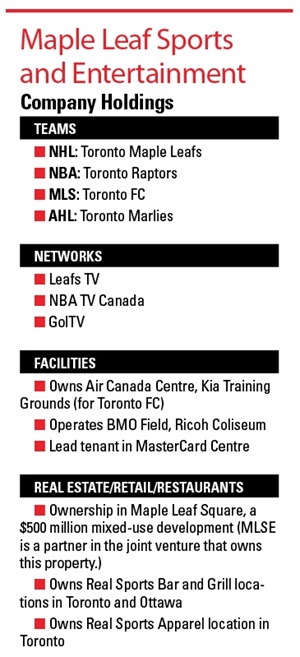
Along with the teams, MLSE owns the Raptors and Leafs’ arena, the Air Canada Centre, one of the busiest buildings in North America. It operates BMO Field, home of Toronto FC, and the Ricoh Coliseum, home of the AHL Toronto Marlies, which MLSE also owns.
MLSE is the lead tenant for MasterCard Centre, the Leafs’ training facility. The company also owns three TV networks: Leafs TV, NBA TV Canada, and GolTV.
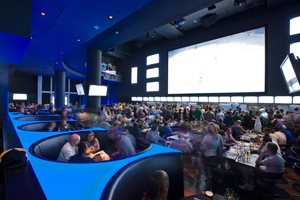 |
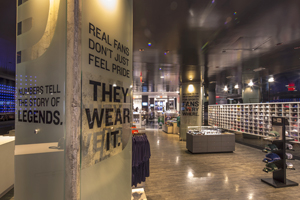
Maple Leaf Square, a $500 million Toronto development in which MLSE is a partner, features condos plus commercial destinations such as Real Sports Apparel (top) and Real Sports Bar and Grill.
Photos by: MAPLE LEAF SPORTS AND ENTERTAINMENT (2)
|
Wrapped around the franchises, the facilities and the networks is a major real estate development, a sports and entertainment district in downtown Toronto known as Maple Leaf Square. MLSE is a partner in the joint venture that owns the $500 million development, which includes 230,000 square feet of commercial real estate along with two towers of 872 condominiums, all of which are sold. The Square features the e11even restaurant, the Real Sports Bar and Grill, a Real Sports Apparel property, and the 162-room Hotel Le Germain.
Signifying MLSE’s bridge between sports and entertainment is a glass-covered walkway linking Air Canada Centre to the adjacent Maple Leaf Square — a bridge, not surprisingly, also built by MLSE.
MLSE owns another Real Sports Bar and Grill location that recently opened in Ottawa, as well. Add it all up, and MLSE has annual operating revenue of $500 million and a 20 percent annual operating profit margin.
“Their business acumen is demonstrated by their revenues that they generate from the hockey and basketball teams at a time when on the ice and on the court they are not as good as they want to be,” said NBA Commissioner David Stern. “They are a really powerful, multifaceted, integrated enterprise. They are known for being aggressive sellers, creative marketers and data-driven decision-makers.”
Under former MLSE Chief Executive Officer Richard Peddie, now retired, the privately held company grew from a $150 million business at its founding in 1998 to today’s $2 billion conglomerate. Other than a private placement tied to its real estate developments, the company is relatively debt free, and in its most recent years it has served as a cash cow for the Ontario Teachers’ Pension Plan.
That plan, which funds the pensions of 300,000 current and retired teachers, had its initial investment through the Leafs, in 1994. The Leafs combined with the Raptors for the creation of MLSE in 1998, and the fund subsequently upped its ante through the years across MLSE’s assets to the tune of $300 million. When it cashed out with the sale of the company last year, it did so with $1 billion in profit based on MLSE’s $1.3 billion transaction price.
The pension plan today lists $118 billion in total net assets.
“The teachers fund was a terrific owner,” Anselmi said. “It was a private equity investment requiring enterprise value growth.”
But note the was: It was a terrific owner. Things are different now, and they’re about to be even more so. MLSE is changing.
A Pure Content Play
It is lunchtime on a Tuesday in Toronto, and the Real Sports Bar and Grill is filling up fast. Diners eat in front of a 39-foot high-definition television and have a choice from 119 beer taps. The 25,000-square-foot restaurant has been profitable since it opened in 2010.
But Rogers and Bell did not buy MLSE for its restaurants and real estate.
Among its vast media and telecom holdings, Rogers, with $12 billion in annual revenue, owns Sportsnet TV along with the Toronto Blue Jays and the Jays’ Rogers Centre home. Bell, with $19 billion in annual revenue, owns the CTV network along with the TSN sports channel, and it has an 18 percent stake in the Montreal Canadiens.
These two companies combined now also control the Maple Leafs, the Raptors and Toronto FC.
The deal faced scrutiny by Canadian media regulators, but the government gave the go-ahead in August, clearing the way for the partnership to proceed.
“You have got two of Canada’s biggest companies buying more live sports programming, and it’s programming that is growing more valuable,” said media industry analyst Brad Adgate, senior vice president and director of research at Horizon Media in New York.
That’s especially important given that media in 2013 means so much more than television. What’s at play is content to distribute through wireless networks, mobile phones and tablets — along with, of course, TV.
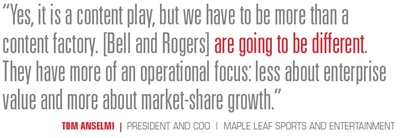
“Yes, it is a content play, but we have to be more than a content factory,” Anselmi said. “[Bell and Rogers] are going to be different. They have more of an operational focus: less about enterprise value and more about market-share growth.”
Currently, television rights for the Leafs are split between Rogers-owned Sportsnet, Bell-owned TSN and MLSE-owned Leafs TV, with CBC separately owning national Saturday night broadcast rights for its “Hockey Night in Canada” franchise. The Raptors’ rights are with TSN and Sportsnet, while Toronto FC’s TV rights are with TSN, Sportsnet and MLSE-owned GolTV.
All of the MLSE team television rights deals expire by 2015, and terms of the Bell-Rogers MLSE acquisition call for the companies to split the newly acquired team content down the middle, though specific details of how that split is made were unavailable.
In total, the structure of the new ownership calls for Bell and Rogers each to own a 37.5 percent stake in MLSE, for a total stake of 75 percent. MLSE Chairman Tanenbaum owns the remaining 25 percent (see related story).
“It is about content, and this is special content,” Tanenbaum said. “Clearly [Bell and Rogers] can use the iconic brands and distribute it to their customer base, and their customer base is all of Canada. It is exciting to the point of having both the resources and expertise to help us make a positive impact across the country for our fans.”
It’s a deal, Peddie said, that was made in part to protect both Bell and Rogers. “It’s both an offensive and defensive move,” he said. And any uncertainty stemming from that seemingly mixed approach is only enhanced by the relative silence from both companies about their plans. Executives from both Bell and Rogers declined to comment for this story.
Said the NBA’s Stern, “It is business as usual, but the new ownership group is experienced in digital and broadcasting and they made it clear to us that they will bring the experience to bear to help grow the property. We expect that their digital experience and breadth will be put to a very intense use to drive the teams and increase our presence in Canada.”
The companies clearly aren’t strangers to doing business together to protect their interests, despite being fierce competitors. They teamed to create a consortium to buy the Canadian Olympic television rights for the 2010 Winter Games in Vancouver and the 2012 Summer Games in London.
“The MLSE deal was a very Canadian solution,” said Cooper, of S&E Sponsorship Group. “Instead of one outbidding the other and then using the content to beat the other to a pulp, Bell and Rogers agree to go in as equal partners, and no one gets hurt. You would never see MSG and Comcast divvy up the business.”
MLSE’s new six-member board includes two executives from Bell and two from Rogers. Rounding out the board is Dale Lastman, a well-known local attorney and MLSE board member under the previous ownership; and Tanenbaum, who quietly has led MLSE during the ownership transition. This newly constructed board will deliver a far different message to Anselmi and other top MLSE executives, who for years took an aggressive growth approach in order to deliver returns for the teachers’ pension plan.
“What was surprising to me is how the deal came together in the way that it did,” said Paul Godfrey, former president of the Toronto Blue Jays, a former Toronto political leader and current chief executive of Postmedia Network in Toronto. “Normally, Bell and Rogers are fierce competitors, but they found an opportunity to join forces in owning the most powerful sports franchise in Canada. My guess is that both companies were concerned the other may get it and they both thought it would be better to share rather than let the other guy get the bulk of it.”
What that means most immediately is that MLSE is downshifting from a growth approach to more of an operations-focused strategy, as Bell and Rogers evaluate MLSE’s business in these first months following their purchase.
“We are taking a pause,” said MLSE Chief Financial Officer Ian Clarke. “We were in a growth mode. My focus will turn inward. We need to improve our brand image.”
A partnership with Live Nation to bring the first House of Blues music venue to Canada has been put on hold. So too has a plan to create an MLSE regional sports network.
“For the day-to-day operations, it is business as usual,” Tanenbaum said. “Yes, there is a pause, and that is fine and we have no issue with that. We do want to focus on winning now. Then the question is, How can we build on the growth and the platform we have. The one thing that has changed for us is that we will not be launching our own sports network. That won’t happen, but we have other growth factors. We can look at our concert area and our food and beverage area.”
A New Agenda
Since the Canadian Radio-television and Telecommunications Commission approved the sale of MLSE in August, there has been one board meeting between MLSE management and its new ownership group. The next meeting is scheduled for next month.
Maple Leaf Sports
and Entertainment
Top Executives
All of MLSE’s top executives have deep ties to the company, and they are known as some of the most sophisticated operators in the industry. Now, however, they must shift the focus of their operations from managing growth for MLSE to managing the company’s core business — at least, in the short term.
 |
Tanenbaum
|
■ Larry Tanenbaum, Chairman
Tanenbaum owns 25 percent of MLSE under terms of the company’s sale to Bell Canada and Rogers Communications, up from 20 percent prior to the transaction. He bought a stake in the Maple Leafs in 1996 and became an owner in MLSE when the company was created in 1998. He is a member of the NBA’s planning committee and as an example of his quiet influence, was one of six NHL owners appointed to the special labor negotiating committee that was formed during the recent lockout in that sport.
 |
Anselmi
|
■ Tom Anselmi, President and Chief Operating Officer
Anselmi, a straight-talking Toronto native, was named president and COO of MLSE in September 2012, just after the sale of the company to Bell and Rogers won approval. Anselmi joined the Leafs in 1996 as vice president and project director. When MLSE was created in 1998, among his new responsibilities was overseeing the building of Air Canada Centre. Since then, he has steadily worked his way to the top of the company’s senior executive staff, serving along the way as chief marketing officer and executive vice president, as well.
 |
| Clarke |
■ Ian Clarke, Executive Vice President, Chief Financial Officer, Finance Administration and Business Development
Clarke joined Maple Leaf Gardens Ltd. in 1990 as controller, prior to the creation of MLSE. He was promoted to executive vice president and chief financial officer in 2004 and has played a key role in spearheading MLSE’s growth through the years, including the $500 million Maple Leaf Square development.
 |
Hunter
|
■ Bob Hunter, Executive Vice President, Venues and Entertainment
A highly respected facilities manager, Hunter has been with MLSE since 1998 and is responsible for the company’s venue and entertainment business at Air Canada Centre as well as at BMO Field, Ricoh Coliseum and MasterCard Centre.
— John Lombardo
“It is a very strategic approach,” said MLSE’s Bob Hunter recently. A few nights earlier, Hunter, executive vice president of venues and entertainment for MLSE, had attended a dinner with executives involved in the sale. “What do we want this company to be? They are interested in growth, but in what areas?”
What insiders expect is a bigger investment in winning for the acquired franchises, because for Bell and Rogers, good teams mean more valuable content to be driven across the companies’ media and telecommunications platforms.
“I believe you will see the Raptors and the Leafs spend until they get a winner,” Cooper said. “MLSE is now part of a much bigger business and it is now about building winning teams to get better programming. It is about getting the content to feed everything else.”
That’s where, in theory, observers might first notice changes with the new ownership: in the win-loss columns. As the losing seasons have piled up for the Leafs, Raptors and Toronto FC, there is the lingering perception among some Toronto sports insiders (and fans) that MLSE has been more interested in profits than team performance.
“Until now, MLSE has generated great profits for its ownership group,” said Reg Bronskill, chief executive officer of The Bronskill Group, a Toronto-based sports and entertainment marketer that counts NHL and MLB teams as clients.“The [pension plan] ownership was a pure investment.”
The retired Peddie, for his part, says any suggestion that winning hasn’t been important at MLSE is “a crock.”
“Winning is good for profits,” Peddie said.
And it’s clear that, despite the teams’ poor performances, efforts have been taken to build winning teams.
MLSE in 2006 hired Bryan Colangelo as Raptors president and general manger on the heels of Colangelo winning the NBA’s Executive of Year the Award in 2005 for his work with Phoenix. The company also, in 2008, hired highly regarded NHL executive Brian Burke as president and general manager of the Leafs. Burke joined Toronto from the Anaheim Ducks, where he saw the team win the Stanley Cup as general manager in 2007.
“The pension fund was hands-off, but they got maligned for only caring about the bottom line,” said Bob Stellick, former director of business operations for the Leafs who now runs Stellick Marketing and Communications in Toronto. “But under their watch, a lot of money was spent on high-priced managers — and success just didn’t come.”
Perhaps a sign of things to come: Consider, some say, last month’s trade by the Rogers-owned Blue Jays with the Florida Marlins that sent five players to the Jays along with some $100 million in salary.
“Rogers and Bell have been quiet, but they no doubt are looking to reinvigorate MLSE,” Bronskill said. “Rogers has allowed the Jays to make a difference, and media is driven by great content.”
More directly, last week, Burke was relieved of his duties as president and general manager of the Leafs. David Nonis was named senior vice president and general manager. Said Anselmi, in a statement, “I’ve worked closely with our [MLSE] Board to evaluate the long-term direction of the Leafs, and as a result of this assessment we have decided to make these leadership changes.”
Before his dismissal, Burke spoke of what he saw ahead for the Leafs for MLSE under the company’s new ownership. “These are two hard-driving, blue-chip companies,” Burke said of Bell and Rogers. “They expect performance from all the teams. They are entitled.”
And more changes are coming — perhaps most notably, in MLSE’s corporate offices. When Anselmi was promoted to president and chief operating officer in September, he replaced Peddie as president, but the longtime MLSE executive did not get the CEO title opened by Peddie’s retirement at the end of 2011. That job remains vacant as the new owners evaluate MLSE. Prior to the sale, the Ontario Teachers’ Pension Plan hired search firm Korn/Ferry International to identify potential CEO candidates. For now, Anselmi is getting his shot at running the company.
Whether the company names Anselmi as CEO or hires someone else for that job is one of the major outstanding questions regarding MLSE. It’s only enhanced by the fact that there is no timetable for any decision.
“We are preparing for a new era,” Clarke said. “It is another turning point for the organization.”