Even if the Boston Celtics eliminate the Philadelphia 76ers from the NBA playoffs by the time you read this, the Sixers will have reaped revenue from at least two more home playoff games than were expected going into the postseason.
Conventional wisdom would have it that the Sixers have been playing with house money since unexpectedly winning their first-round series against the Eastern Conference’s No. 1 seed Chicago Bulls. Whatever money they are playing with, there’s more of it thanks to a new ownership group that took control Oct. 18 from Comcast-Spectacor. Still, the team won’t be playing with a full deck until July, as that’s when it will begin selling its own marketing assets. The team’s sponsorships have been sold by a Comcast-Spectacor subsidiary for 15 years.
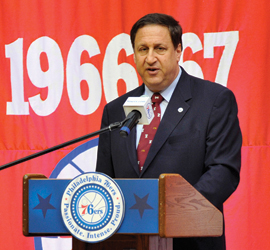 |
Sixers CEO Adam Aron expects big gains in sponsorship sales.
Photo by: NBAE / GETTY IMAGES
|
Combine that lack of marketing assets with a very uneven on-court performance over the years, and revenue for the No. 5 market team was at or near the bottom of the league by nearly every measure — and had been declining — for a decade.
With sponsorships rights restored in July, the team is rebuilding a sales staff and will soon hire a new sponsorship chief who will face renewals in the beer, health care, quick-service restaurant and wireless categories, among others. Under terms of the sale agreement, TV rights remain in the hands of Comcast-Spectacor, not quite in perpetuity, but almost. As far as basketball-related advertising and inventory within the bowl at Wells Fargo Center, it’s a small base to build from, as the team’s sponsorship revenue is 6 percent of ticket revenue, leaving a lot of upside.
“We can easily do two to three times better,’’ said team CEO Adam Aron, also a member of the team’s ownership group and whose marketing résumé includes doing the United Center naming-rights deal while he led marketing at the airline.
Looking at what the team has done to build a similarly neglected season-ticket base, it’s easy to affirm Aron’s conviction that “there’s nothing but marketing upside.” Over the first season of the new ownership group — which bought the club just in time for a lockout — attendance grew from an average of 14,751 (25th in the NBA) to 17,503 (14th in the NBA), and Aron said that since comps were down considerably, the Sixers actually sold more paid tickets for a 66-game season than for the prior 82-game season, even with lockout-related scheduling peculiarities like 13 home games in January and the last five regular-season games on the road.
The season-ticket base for next season has increased from 3,294 to 5,438, and Aron said that number should be at or around 6,500 by opening night of next season. Revenue per seat has increased due to rescaling and the reduction of rampant discounting and comps.
The team in July will move into its own office space at the old Philadelphia Navy Yard while maintaining its offices at Wells Fargo Center. Also on the to-do list is building a practice facility to replace the one at Philadelphia College of Osteopathic Medicine, where, until recently, players competed with students and faculty for parking spaces. Aron said ownership is committed to building a new practice gym, which would cost between $10 million and $30 million. “I’d be surprised if we’re not in the design phase of that by fall,’’ Aron said.
Of course, that would also be an important new piece of sponsorship inventory. We’ll be intrigued to see what happens once the Sixers are more fully armed — on and off the court.
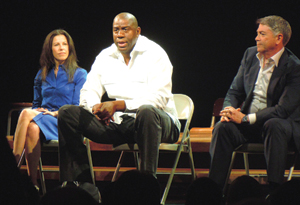 |
Tony Ponturo (right, with Magic Johnson and co-producer Fran Kirmser) isn’t giving up on sports-themed plays.
Photo by: TERRY LEFTON / STAFF
|
PLAY BILL: Tony Ponturo’s first few experiences as a Broadway producer were boffo. He was in on hits like “Memphis” and the revival of “Hair,” both of which won Tony awards. More recent efforts at integrating sports and Broadway have been more challenging, with “Magic/Bird” closing earlier this month after a run of four weeks, while the earlier “Lombardi” had a 244-day run on Broadway from 2010-11. However, the former Anheuser-Busch sports marketing chief says the beer glass is half-full. While he’s not talking in great detail about it, even with the stage lights at the Longacre Theater just dimmed after “Magic/Bird,” his Kirmser Ponturo Group has another sports-themed theatrical production under development and awaiting rights clearance.
“We’re trying to create a new space, which is never easy, but we still think there’s opportunity there,” Ponturo said, adding that he believes there’s still ample licensing opportunities for both earlier plays. “Lombardi,” for example, had an eight-week run in Milwaukee and will be performed later this year in Cleveland, Dallas and Phoenix.
As for lessons learned after two efforts of what Ponturo hopes is a developing genre? “You need to give the audience something they don’t get every day from ESPN or whatever, and while sports are primarily local, you have to have a subject relevant enough to be larger than the story and national in scope,” he said.
In an ideal scenario, a third sports play from the Kirmser Ponturo Group could be on the stage in as soon as 18 months.
 |
| Allphin |
COMINGS & GOINGS: Sarah Davis joins GMR Marketing’s Charlotte office as vice president, client management, overseeing the HBO, Speed, Cintas and Best Buy accounts. She was senior director of business affairs at the IRL. Davis, who will start in June, replaces Tamera Green, who left GMR earlier this month. … Van Wagner Sports & Entertainment has hired Chris Allphin as a vice president in its new Los Angeles office, headed by Jeff Knapple and concerned largely with venue revenue. Allphin worked with Knapple for 12 years at Wasserman Media Group and Envision. He also worked at AEG.
Terry Lefton can be reached at tlefton@sportsbusinessjournal.com.