On the Friday before the Super Bowl, a crowd of about 20 people jostled each other trying to take Vanilla Ice’s picture or get his autograph as he sat down for a Radio Row interview with Nestor Aparicio, the owner of a small Baltimore radio station.
Other celebrities were drawing much bigger crowds in the third-floor JW Marriott ballroom that made up this year’s Radio Row in Indianapolis. It was difficult to move around the SiriusXM booth as Rosie O’Donnell hosted her show. Fans stood about four deep to catch a glimpse of Adam Sandler as he made the rounds to promote an upcoming movie.
Still, there was something telling about the fact that a C-list celebrity giving an interview to a small, 5,000-watt radio station would draw such a crowd. It speaks to the craziness of Radio Row, the Super Bowl’s annual orgy of buzz and promotion. But it also speaks to the enduring popularity of traditional radio.
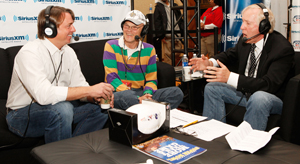 |
SiriusXM host and Hall of Fame quarterback Fran Tarkenton (right) broadcasts from the Super Bowl’s Radio Row, joined by chef John Besh (left) and political strategist James Carville.
Photo by: Getty Images |
The media world is consumed with the latest digital technology. In radio, that means everything from live streaming and interactive apps to audio and video podcasts. But it was good, old-fashioned sports talk radio — yes, the Marconi invention — that proved to be more popular than ever during Super Bowl week this year.
By almost every measure, sports talk radio, the traditional “stick business,” is going through a renaissance.
“There’s never been more sports radio stations than there is now,” said Dennis Wharton, an executive vice president with the National Association of Broadcasters. “It would be great if former station owners got back into the business with highly localized sports stations. There’s just a tremendous appetite and audience for that.”
The number of sports talk radio stations in the United States has grown by a whopping 64 percent in the 10 years since 2002, according to figures from Inside Radio, a trade publication covering the radio industry.
In 2002, 413 stations were sports talkers. By last year, that number had jumped to 677. The number of sports talk radio stations has grown every year for at least the past 10 years.
“We’ve gone from a time when the industry openly ridiculed the idea of a full-time sports station to an environment where some markets have three or even four all-sports radio outlets,” said Tom Taylor, a radio industry analyst with Radio-Info.com.
That trend shows no signs of slowing down, especially given the desirable young male demographics sports talk radio attracts and the local nature of sports talk radio.
“Sports talk radio is a local programming platform,” said Scott Becher, an executive with Federated Sports and
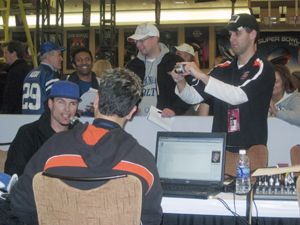 |
Vanilla Ice drew a small crowd while doing an interview with Baltimore radio station WNST.
Photo by: John Ourand / Staff |
Gaming, who launched 790 The Ticket in Miami. “While other formats tend to be national and more competitive with satellite radio, it’s much more difficult for a sports fan to get a daily fix for their local teams other than in sports talk. Local still matters.”
A recent trend of launching sports talk stations on FM also is fueling growth in the genre. CBS Radio launched its first FM sports radio station in 2008 with WXYT in Detroit. At the end of 2011, 125 sports talk radio stations were operating in FM across the United States, according to broadcast research group BIA/Kelsey.
“The explosion has been moreso, in a lot of markets, AM stations moving their programming over to an FM property, and reaching younger and bigger audiences with it,” said longtime radio veteran Tom Bigby, a former executive with CBS Radio. “It opened up a brand-new market on FM. That’s a lot of the reason why we’ve seen the explosion of sports radio because it migrated to FM, where a lot more people were.”
Seeing an opportunity
The poster child for the growth in sports talk radio could be Craig Karmazin. The son of Sirius XM Radio CEO Mel Karmazin, Craig was an early believer in putting sports talk radio stations on FM and has built a small array of sports radio stations across the country.
Karmazin was just 22 years old in 1997 when he secured a $3.5 million loan to buy stations near Madison, Wis. He signed a deal to carry Howard Stern’s morning show followed by sports talk for the rest of the day. Four years later, Karmazin bought another small station in West Palm Beach, followed by another one in Milwaukee and one more in Cleveland.
“As such a young business owner who had gone into a lot of debt to start a company, at that point I decided that I really didn’t believe in radio long term,” Karmazin said. “But I believed in sports and sports radio long term.”
That viewpoint represents one reason why more people are launching sports talk radio stations these days. It’s popular with the desired demo of young men (see charts, page 20). And its live talk format makes sports talk radio a safer buy than music formats that have been hurt by streaming apps like Pandora and personal devices like iPods.
“By 2002, I didn’t want to be in the radio business; I wanted to be in the sports radio and sports marketing business,” Karmazin said. “Traditional radio stations that are a jukebox don’t work any more. There’s too many other options with satellite and Internet-based and iPods and other technologies. Sports is a great way to find a connection to a community and really get results for advertisers.”
Today, Karmazin’s Good Karma Broadcasting operates eight ESPN-affiliated stations, including seven in top 100 markets. Karmazin relies on ESPN Radio programming to fill a good part of his schedules.
“Being able to bring advertising partners the brand of ESPN, and then being able to combine that with the local elements that our marketing partners want is a great balance,” Karmazin said.
Traug Keller, ESPN’s senior vice president of production and business divisions, said that Karmazin’s story is not unique in today’s radio world.
“There are upstart mom-and-pop operations happening now,” Keller said. “Craig’s making a nice little business of it.”
Big media companies like ESPN and Fox Sports continue to maintain a presence in radio. Both companies try to negotiate for radio rights as part of overall rights deals they negotiate with leagues and teams.
Bill Wanger, Fox Sports’ senior vice president of research and programming, pointed to the network’s recent World Cup negotiations, which included radio rights for the United States. It wasn’t a big part of the deal, but Fox Sports wanted to make sure they controlled it.
“Any cross-platform deals we’re doing, radio is a part of that,” Wanger said. “Radio is an integral part of the Fox Sports Media Group. It’s a great platform to enhance your brand.”
Fox Sports Radio is run through a partnership with the Premiere Radio Network. It has seen ad revenue growth in the low single digits over the past year, Wanger said.
ESPN would not break down revenue for its audio. But Keller said it’s particularly successful when its programming is used on different platforms.
“Radio is underestimated in its appeal to the average listener and fan,” he said. “There is an authenticity to radio that works in some ways on television. The reason you see the success of ‘Mike & Mike’ — and you’re seeing it pop up in other places locally like with ‘Boomer & Carton’ on MSG in the morning, there’s something appealing about people watching a radio show unscripted, versus the television world that’s scripted.”
The future
Traditional sports talk radio may still be growing, but, so too are new technologies that show where the industry is heading. Every radio executive contacted for this story is using new technologies such as podcasts and Internet streams to enhance the traditional radio telecast.
“The digital world of sports radio is infinity,” Bigby said. “There’s so much more that we can do.”
ESPN has been at the forefront of experimenting with it, going so far as to call the business “audio” rather than “radio.”
ESPN streams its radio programs on the Internet, televises them on its TV channels, and has apps for them for mobile
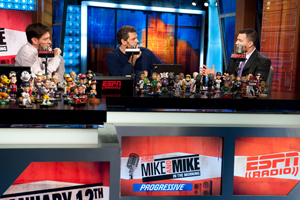 |
ESPN refers to the business as “audio” rather than “radio” as the network streams its radio programs across multiple platforms.
Photo by: Joe Faraoni / ESPN |
devices. Yet Keller says ratings at the core radio stations have not suffered at all.
“All these new things are additive,” Keller said. “That’s a phenomenon that I’m going to peg for the past two years because of the rapid proliferation of the smartphone, led by the iPhone, which is kind of today’s Walkman, except that it is much more prolific than the Walkman was.”
ESPN first saw the power during the World Cup, when ESPN Radio made its games available on multiple platforms.
“We got our regular ratings for World Cup,” Keller said. “Then we got a 40 percent bounce when you took in all the additional ways people could listen.”
The numbers ESPN gets for its podcasts are impressive. Bill Simmons, for example, averages 700,000 downloads per podcast — an audience number any radio show would be thrilled to pull.
“It’s not a traditional radio show by any measure,”Keller said. “But it is extremely popular. It’s another example of how new media for audio has extended the medium of audio’s reach.”
Podcasts have become a staple of virtually every radio show. Most use podcasts as a way to make shows available on demand.
“It’s a convenient way for people to hear shows that they missed,” said Dan Mason, president and CEO of CBS Radio. “We’ve embraced podcasting. That’s more of the future, that we’d be able to offer an either-or situation.”
Maintaining a digital presence is especially important to smaller stations, like Aparicio’s WNST. Aparicio bought the station for $1 million in the fall of 2000. The station’s signal is so weak, particularly after dark, that Aparicio depends on a website to make his content available to more people.
“We’re growing because of the Web,” Aparicio said. “There’s no way radio is going to survive if you’re just doing radio.”
The problem is that radio ad dollars have been slow to move to digital, Aparicio has found. However, former Baltimore Ravens coach Brian Billick is an investor in the station and said he has confidence that ad dollars will follow eventually.
“This is where we’re going,” Billick said. “This is the future. We have no idea how to monetize it yet. But those who are spending the money online are beginning to get that.”