As a reformed litigator making the transition to talent agent in 1989, Marc Perman saw something uniquely marketable in a young Charles Barkley. The "Round Mound of Rebound" at the time was an ascending 25-year-old NBA star with the Philadelphia 76ers going through a transition off the court. His relationship with agent Lance Luchnick had collapsed into a cesspool of bad blood, shoddy investments and accompanying lawsuits, so Perman saw an opportunity and contacted Glenn Guthrie, who has been Barkley's business adviser since L'Affaire Luchnick.
Over a burger at a now-defunct sports bar in Birmingham, Ala., Perman made his pitch. It was that the 6-foot-5 Barkley, who scored and rebounded like a 6-10 star, had enough charisma to become a potent commercial spokesman. He was outspoken, articulate and genuinely funny. "I knew he'd have an enduring career after basketball, even though I didn't know it would be broadcasting," Perman said.
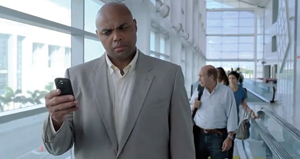 |
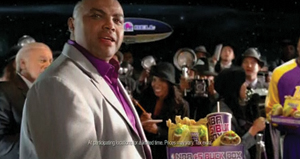
| Barkley did a Super Bowl ad for Taco Bell (top) and is a familiar face for T-Mobile. |
More than 20 years later, Barkley is a fixture on the NBA scene. He is an uber-popular TV analyst for Turner Sports, he is in the Basketball Hall of Fame and has shot enough commercials that neither he nor Perman are sure exactly how many ads he's done for the likes of McDonald's, Nike, AT&T, Right Guard, T-Mobile and Taco Bell, which had Barkley in a Super Bowl ad last year.
"We're somewhere between 50 and 100, I guess," said Barkley, in his trailer between scenes at a recent T-Mobile ad shoot in Miami, "but really, I am very particular."
Having put Brian Bosworth and Kirk Gibson into TV ads for Right Guard, it was natural that Perman's first deal for Barkley in 1992 was for the same brand. The NBA was in season, so Barkley flew between games by charter jet to Charlottesville, Va., the heart of fox-hunting country, to do the first of a pair of memorable Right Guard spots. It was Barkley's first non-endemic ad, and Perman saw instantly that not only was Barkley a good actor, he was dedicated. "He got off the plane with that script memorized,'' Perman recalled.
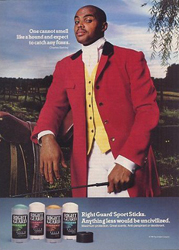 |
| The Right Guard ads set the tone for Barkley's later work. |
From then to now, his prowess as a pitchman and commentator has only increased. Guthrie says he's not surprised. "He's gotten better at every level. So when people say to me he's a better TV personality than ever, I just tell them, I've seen him get better at everything he's done. Charles knew that the NBA was an entertainment business long before I did."
Arguably, the 11-time all-star is a bigger star now than when he was playing. Recent data from the Davie-Brown Index supports that contention, finding that Barkley is known by more than 82 percent of U.S. consumers, about the same number as LeBron James, Ringo Starr, Derek Jeter and John McEnroe. Barkley's trust levels, as measured by the DBI, are on par with Peter Fonda, Jay-Z and Thierry Henry.
As an NBA rookie, Barkley decided not to take any of the easy-money offers to pro athletes for what are often cheesy local ads for car dealers, electronics retailers and burger joints. The Philadelphia-area McDonald's co-op knocked on Barkley's door every year he played for the 76ers (1984-1992). He didn't pitch for McDonald's until it was on a national scale, appearing in various spots, including one of the many follow-up ads for the classic Larry Bird-Michael Jordan showdown, "nothing-but-net" ad.
His success is a result of his candor: Barkley is brutally honest, well-informed and genuinely funny — rare commodities in people and more so in athlete/endorsers. He's Teflon enough and popular to the degree that a guy once fined for spitting on fans, and more recently arrested for DUI when he told police the reason he ran through a stop sign drunk was because of a sexual escapade, can get paid to represent national brands.
True to form, Barkley says too much of him can be, well, just too much. "One thing I get uncomfortable with during the playoffs is when, in every commercial break, they are showing one of my commercials," he said. "Then it just annoys me."
Perman says he routinely rejects one-offs, looking for long-term deals of seven figures. He spurned offers from weight-loss products, despite Barkley's recent shedding of more than 40 pounds. Essentially, it's about finding appropriate creative, like those first Right Guard spots, where he was effectively cast in two "fish-out-of-water" roles, as an equestrian and an archaeologist.
"Those ads weren't about slam-dunking a basketball. They established the self-deprecating face of Charles and were the blueprint for everything we've done since," Perman said. "The campaign is almost more important to us than the product and the compensation, because, like a film career, it leads to the next project. We've been doing it long enough that I can sense if an ad is good from the storyboards."
PRIME CHUCK Charles Barkley, an NBA broadcaster since 2000 following a 16-year career as a player, has the ability to influence brand affinity and consumer purchases, according to the Davie-Brown Index, which measures a celebrity’s attributes. From a national online panel, 1,000 respondents are presented with the name and face of a celebrity and asked if they are aware of the individual. That number is represented here as a percent. Respondents who indicate that they are aware of the celebrity are then asked a standard set of questions about that celebrity, using a six-point scale to record their responses. These questions form the basis for the weighted scores, not percentages, for select attributes measured by the survey.
|
|
|
|
Michael Jordan (22) |
98.1% |
64.1 |
75.8 |
Magic Johnson (94) |
94.3% |
62.7 |
70.3 |
LeBron James (376) |
82.1% |
51.1 |
66.2 |
Charles Barkley (403) |
82.9% |
53.6 |
61.2 |
Larry Bird (413) |
82.3% |
56.0 |
60. |
Notes: Awareness indicates the percentage of consumers who are aware of the celebrity either by name or by face. “Trust” indicates the level of trust that the consumers place in the celebrity’s words and image. “Endorsement” reflects the degree to which consumers identify the celebrity as being an effective product spokesman. |
Barkley's been supporting T-Mobile's NBA sponsorship by appearing in ads for the carrier for the past five years. "We originally picked Barkley because he fit well into the creative," said Mike Belcher, T-Mobile vice president of sponsorships and events. "We also felt he was underleveraged commercially, relative to his overall profile, which allowed us to get more out of him. Over the years, we've found that he's dedicated, professional and accomplished. Whatever the script is, he usually nails it quickly, and he's always great with our customers and our employees."
Any commercial spokesman with Barkley's staying power is an anomaly. He has been with Nike since his rookie year 27 years ago. The best explanation for his endurance is the most obvious one — his outspokenness. "He's candid to a fault, and that's not necessarily something you see in a lot of athlete endorsers," said Mark Zablow, senior director of marketing at Platinum Rye Entertainment, who matches personalities and brands for clients that include P&G. "As a result, he's underleveraged, when you consider how recognizable he is."
Or as former Turner Entertainment President Mark Lazarus said countless times when describing Barkley's success as an on-air talent: "He knows how to straddle the line without crossing it."
Doug Shabelman, president of talent broker Burns Entertainment & Sports Marketing, said: "Barkley clearly relishes being front and center, and he's still relevant to a wide range of ages. You can't say that about many athletes, retired or otherwise, and that's why he has lasted so many years."
Perhaps the most fascinating thing about Barkley's success as a pitchman is hearing his rationale for doing them. It's the same reason he is attracted to politics — there is a deep-seated need to connect and communicate.
"I don't do commercials just for money, 'cause I don't need the money," he says with a shrug. "I do them because it keeps me relevant, so then I get to talk about stuff that I really want to. You just can't show up and be significant. The one thing that TV commercials do is they keep you out there."