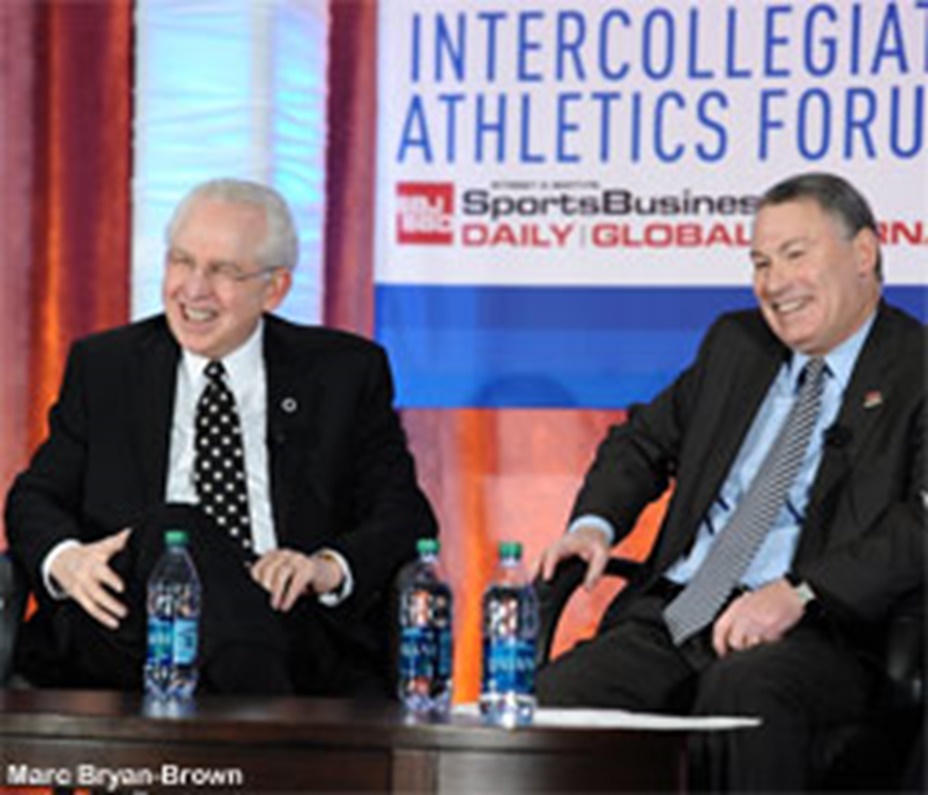
The topic of BCS conferences breaking away from the NCAA inspired a lot of conversation among conference commissioners at the opening panel of Day Two of the IMG Intercollegiate Athletics Forum. When asked why the 65-70 schools in the five power conferences -- ACC, Big Ten, Big 12, Pac-12 and SEC -- need to stay in the NCAA, SEC Commissioner Mike Slive said, “There certainly needs to be an umbrella organization and we certainly have one. The issues that need to be thought about are ‘what should the NCAA be doing?’ and ‘what should the NCAA not be doing?’” He added, “It certainly needs the value of championships, the value of umbrella legislation, the value of infractions and compliance. Whatever organization exists is going to have to do those kinds of things. I think that the issue at least from my seat is whether or not in certain areas we can be accurately accommodated for those issues that we believe are good for us, and often times good for student-athletes. … At some point it’s going to be very important that Dr. (Mark) Emmert to be able to continue to find a way to accommodate us in those areas. Whether changing an organization is the answer, I think the answer more is accommodation.” Big Ten Commissioner Jim Delany said, “I think the NCAA can survive; it’s always been a little bit of a lightning rod for schools and conferences who really have a hard time governing themselves.” He added, “I’ve spoke on the cost-of-education issue for a number of years now. We’re supportive of that, at the same time I can’t tell you that everybody from a high-resource institution wants to see that. There’s not unanimous (thought). I applaud Mark Emmert for addressing this head-on both with both presidents and conference commissioners. He’ll ask us whatever issues we need to have addressed, and sometimes we find out you say things one day, come back to vote six months later and we’ve got changing minds.”
PLENTY OF THINGS IN COMMON: Slive said there is a “tendency because of revenue and television to talk about separation,” but the reality is that “all of us at the NCAA have more commonality than we do separation.” Slive: “This is about higher education, we come here and we talk about television and about all the glitz and the glamour of the national championship game, but in the final analysis, what we all have in common in the NCAA is that we are competing athletically as part of higher education. That we have in common. We don’t need another organization for that purpose. Now the question is how do we just manifest through various ways some of the differences that we have. But the NCAA and us, even though we don’t get a lot of credit for it, we are involved in an enterprise that is part of higher education and part of the culture, so we have that in common and that shouldn’t change." Delany said, “I want to be in the same large tent with the Ivy group. I want to be in the same large tent with Ohio Valley and the Southern Conference, the MEAC and the SWAC. I want them to have an opportunity to play major college sports. They may play a little bit differently; their goals may be a little bit different. I just want to be able to do certain things, to have certain flexibility and not be restricted." Big East Commissioner Mike Aresco said, “We need the NCAA for a lot of reasons.” He added, “The conferences can’t look to the NCAA to solve certain problems. The NCAA can be an enforcement mechanism, but the conferences have to figure out governance, the conferences have to figure out the best way to proceed when it comes to how we recruit, how you deal with student-athlete life and other issues."
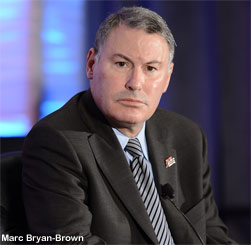 |
Aresco notes the NCAA has to adapt to different
needs of the various conferences |
NOT ALL CONFERENCES CREATED EQUALLY: Aresco noted not every conference is the same and view themselves in a certain way, meaning the NCAA “has to adapt to that and it’s not an easy job.” Aresco: “I obviously have not been a commissioner as long as (Slive and Delany), they have far more experience in a lot of these situations, but I agree with Mike. Sometimes we forget it is about the student-athletes.” He added, “We look to the NCAA for guidance, and we also feel like we should be proactive to talk to the NCAA about issues that concern us. We’ve had some recently and after consulting with other commissioners, we’ve come to conclusions and taken them to the NCAA and they will consider them. In the end, I don’t think there’s any question that we need an organization like the NCAA. Everybody wants a level playing field, I don’t know if there’s ever really a level playing field. Everybody wants to feel certain we’re moving in that direction and the NCAA serves a real purpose there.”
GROWTH SPURT: Delany discussed the conference’s recent addition of Maryland and Rutgers, saying, “The paradigm has shifted and all five major conferences are outside their footprint. … We saw continuing changes and we thought there were more risks embracing the status quo.” Delany acknowledged that realignment at times is not popular with the conference fan base, and “we have lost some things that are very valuable.” Delany: “There may be some ambivalence (about new markets), but I think over time that can be overcome if the institutional connections and the competition (are able to grow.)” When asked how much Fox and Big Ten Network influenced the decision to add the two schools, Delany replied that they were not consulted and surprised many in the room. “We made the move we made because we thought the Big Ten as a conference, not for the Big Ten Network, but as a conference (the Big Ten) would be in a great position for the next decade.” Meanwhile, Slive said in regards to realignment, he prioritizes geographical identity over media possibilities and has to ask himself before adding a new school, “Will the SEC be the kind of preeminent conference 20 years from now that it is today?”