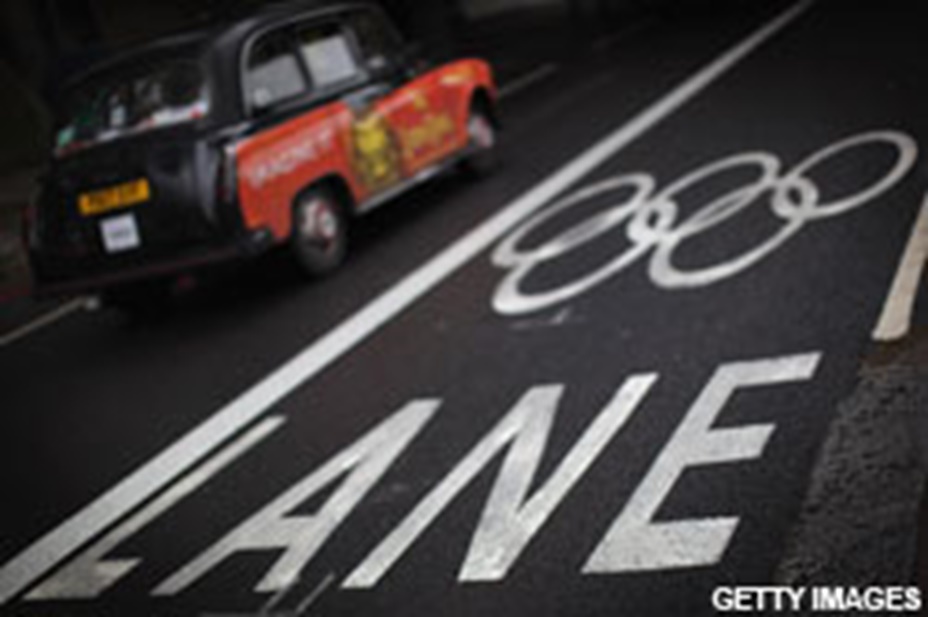
Volunteer bus drivers yesterday from Scotland, Northern Ireland and other parts of the U.K. -- along with satellite navigation systems that “did not include the address of the Olympic Village -- turned what was supposed to be a seamless journey along clear ‘games lanes’ into an exhausting schlep through London congestion,” according to Robert Booth of the GUARDIAN. USA Track & Field coach Tom Pukstys “described how he and 25 other members of the team who flew overnight to Heathrow from Chicago faced a four hour drive across London when their Scottish driver got lost.” Pukstys said, "I was watching the satnav and it was telling us to go one way, then another. It was the first time he (the driver) had made the trip. If you are going to competition and get lost that would be devastating. But that's not going to happen." USOC Chief Communications Officer Patrick Sandusky said there had been "some limited challenges for some of our athletes travelling from Heathrow to the Olympic Village." But he added, "One bus trip doesn't detract from that a bit." A LOCOG spokesperson said, "It is day one and we have only had one or two issues where journeys have taken longer than planned. The vast majority of journeys have been fine." Despite the transportation delay and bad weather in London, the athletes' “spirits remained high” when they reached the Olympic Village. U.S. runner Tony McQuay tweeted: "I don't think I want to leave the UK sorry US lol but I'm loving how they build this village for us to stay in … Wow!" U.S. hurdler Kerron Clement also “appeared to have cheered up.” Clement tweeted, "Eating at the Olympic Village. Love the variety of food choices, African, Caribbean, Halal cuisine, India and Asian and of course McDonalds" (GUARDIAN, 7/17). U.K. travel writer Simon Calder said the London highway system is, "frankly, a disaster." Calder: "It was based on a plan originally put in place by the Romans 2,000 years ago and much of it hasn’t improved very much since then” (“CBS This Morning,” CBS, 7/17).
SIGHTSEEING: In London, Jacquelin Magnay notes the drivers “hired by London Olympic organisers had not driven or been shown the route before, and could not operate the GPS navigation system fitted in the vehicle.” The result was “a journey which took the tired and bemused athletes past Buckingham Palace and the Houses of Parliament before finally crawling to its destination.” The blunders were “an embarrassment to London’s Olympic organisers, especially as yesterday marked the point at which the world’s media began to take a special interest in the event.” Some of the Olympic venues, "like the athletes’ village location, have not been pre-loaded” on bus GPS systems. Australian Olympic Committee Media Liaison Officer Damian Kelly said, “It would have been a great tourist trip if that is what you are here for” (London TELEGRAPH, 7/17). In London, O’Connor, Pank, Buchanan & Ford noted the two buses carrying members of the Australian and American teams “took up to four hours to travel the 25 miles” from Heathrow airport to Stratford, East London -- a trip that normally averages “two hours.” On a day when Heathrow "processed a record number of passengers and the first of the dedicated Games lanes began operating, there was confusion on the roads not only for ordinary motorists but also for the official drivers.” A LOCOG spokesperson said that its volunteer drivers, "mostly Londoners, had received training and that only two out of 100 journeys had experienced problems” (LONDON TIMES, 7/17). London Transport Commissioner Peter Hendy said, "I can't believe it would have been four hours -- they would have had to get seriously lost (PA, 7/16). Kelly said that the Australian group had "taken the extended detour in good humour" (SYDNEY MORNING HERALD, 7/17).
EASE OF ARRIVAL: In N.Y., John Burns notes Heathrow had "none of the three-hour backups that have plagued the airport in recent days, raising fears of gridlock with the Games less than two weeks away.” Instead, travelers “passed smoothly through passport control, many in just minutes” (N.Y. TIMES, 7/17). The FINANCIAL TIMES’ Jacobs & Blitz note the “smooth operation at Heathrow on its busiest day in history came as a relief to many.” Danish soccer players, Dutch beach volleyball players and Russian sailors all said that “they had passed through immigration in less than half an hour” (FINANCIAL TIMES, 7/17). The LONDON TIMES' O’Connor, Pank, Buchanan & Ford note the “longest immigration queues were at Terminal 4, where waiting times were 20 minutes.” The airport “processed 236,955 passengers, compared with an average of 190,000” (LONDON TIMES, 7/17). The AP’s Raphael Satter notes Heathrow “put half of its 1,000 volunteers on duty and created special teams to deal with the oversized gear of the athletes” (AP, 7/17). In London, Simon Calder notes the “main baggage drama involved three sails belonging to the Australian sailing team who flew in on Qantas.” The missing equipment “was eventually tracked down in a cargo shed, where it had been taken in error because of its size, and re-united with the team” (London INDEPENDENT, 7/17).