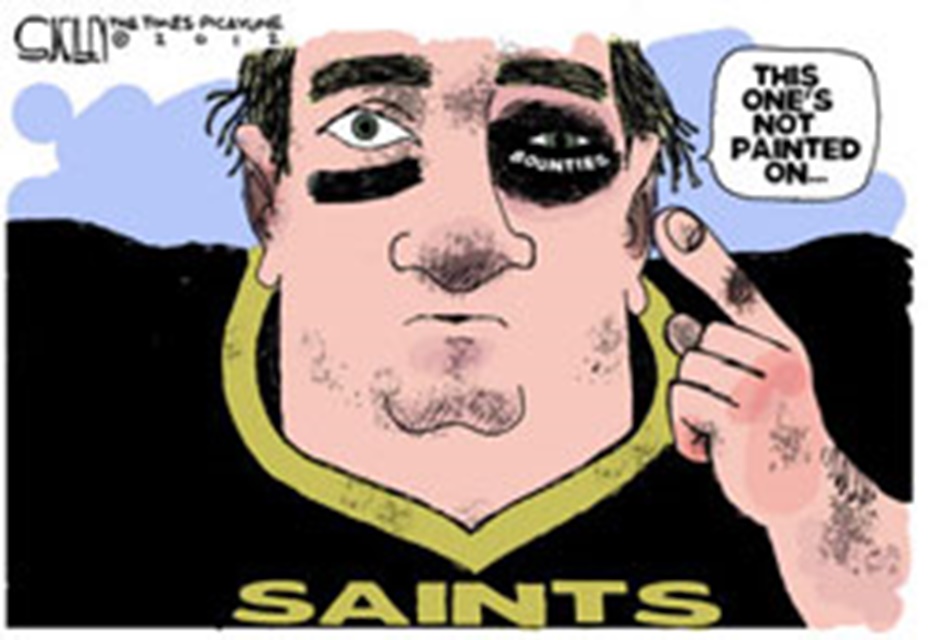
Saints GM Mickey Loomis and coach Sean Payton yesterday in a statement apologized to Owner Tom Benson "for their part in the bounty scandal that has roiled the franchise, and the pair also vowed nothing similar will unfold again in New Orleans under their watch," according to James Varney of the New Orleans TIMES-PICAYUNE. Neither Loomis nor Payton "have spoken publicly about the matter, which engulfed the Saints last Friday." Yesterday's statement "did not directly address the NFL's accusations." The statement began, "We acknowledge that the violations disclosed by the NFL during their investigation of our club happened under our watch. We take full responsibility. This has brought undue hardship on Mr. Benson, who had nothing to do with this activity. He has been nothing but supportive, and for that we both apologize to him." Sources said that Benson's confidence in Loomis and Payton "has not diminished." Both Loomis and Payton reportedly "were at work Tuesday, supremely unruffled" (New Orleans TIMES-PICAYUNE, 3/7). ESPN's Michael Wilbon said of the apologies, “This is the minimum they owe, but just because you apologize for something, it may lessen the punishment a little bit but there still ought to be big punishment coming” ("PTI," ESPN, 3/6). Pro Football Talk’s Mike Florio: “The phrase, ‘This will never happen again,’ is probably the understatement of the century. This better never happen again” ("NBC Sports Talk," NBC Sports Network, 3/6).
A LITTLE BACKGROUND: SI's Peter King in a cover story notes the NFL's investigation into the scandal "was dry-docked" following the '10 NFC title game in which the Saints allegedly "put a bounty" on then-Vikings QB Brett Favre. But during the latter part of the '11 season, the league said that it "received 'significant and credible new information' that the bounty program did exist in 2009 and continued through '11." Before the Saints' Jan. '12 playoff game against the Lions, the league "informed Benson of the renewed investigation." At that point Benson "allowed NFL officials and outside forensic experts to gather evidence, including copious club e-mails, related to the bounty program." Benson also told the league that he would "contact Loomis to make sure the program wasn't in place." One of the documents examined by the NFL was an "e-mail from a former team consultant, Mike Ornstein, to Payton, allegedly pledging $5,000 toward a bounty on an opposing quarterback." A source said that Ornstein -- "at one time a close confidant of Payton's who in October 2010 would plead guilty to federal fraud and money-laundering charges in connection with the scalping of Super Bowl tickets and the sale of bogus game-worn NFL jerseys -- claimed he was kidding about the pledge, but the league took it seriously." Confronted with the note from Ornstein, Payton "expressed surprise and said he hadn't read the e-mail." King notes the inclusion of then-Saints LB Scott Fujita's "name in the investigation is noteworthy." During last summer's CBA negotiations, Fujita and former NFLer Sean Morey "pushed hard for improvements in working conditions, including fewer full-contact practices during the season." Fujita said, "You don't spend time with guys like Sean Morey and other former players, or have close friends whose health fails them, possibly because of this game, and not be affected by that. I wanted to be part of the paradigm shift." King notes it is likely NFL Commissioner Roger Goodell "will come down hardest on Williams, Payton, Loomis and [Saints LB Jonathan] Vilma, in that order," while Benson "appears to be in the clear" (SI, 3/12 issue).
A SCARLET LETTER: SI.com's Don Banks noted the NFLPA "has been mostly quiet so far in the early days of the Saints saga." When the union "does weigh in, it's expected that it'll line up in defense of the players on all fronts, both those who were targeted by bounties and those who did the targeting." The NFLPA will "no doubt also welcome any measures taken by the NFL to eliminate such practices from the game, thereby making it safer." The Saints "will proceed into the offseason with a cloud that looms over their 2012 season." The Saints have a "bit of a stage this coming NFL season." They will play the Cardinals in the Aug. 5 HOF Game in Canton, and will "play host to the NFL's final game of the season, too: Super Bowl XLVII in the renovated Superdome on Feb. 3, 2013." Those will be "spotlight opportunities for the Saints, and it's hard to imagine their season won't be continually cast amidst the backdrop of the bounty pool scandal" (SI.com, 3/6). SI.com's King wrote there is "going to be a scarlet letter on the franchise over this issue" (SI.com, 3/6).
ANOTHER HEADACHE: USA TODAY's Gary Mihoces notes legal opinions "are split on whether a player who was the target of a bounty might have grounds for a suit." But bounties "might come into play on another legal front: the barrage of concussion-related lawsuits filed against the NFL by former players" (USA TODAY, 3/7). NYU sports law professor Robert Boland said that the NFL "faced another challenge -- to its public perception." He said, "The worst image the NFL could have is that the sport ... gets minimized because of the danger. It becomes gladiatorial to the degree that boxing has now suffered. It's not that boxing is without fans, but boxing certainly has become marginalized because of the violence" (USA TODAY, 3/7).