I did a quick trip for the NBA All-Star Weekend, mostly centered around the Tech Summit on Friday morning. Here are a few takeaways from my time in Houston:
■ One clear observation was the continual transition of leadership from Commissioner David Stern to Deputy Commissioner Adam Silver. This wasn’t prevalent during the Tech Summit, which Stern still opened and closed, but it was evident during the annual State of the League press conference, which I watched Saturday night on NBA TV. During the session, Stern referred (or deferred) to Silver on a number of questions. At one time, Stern looked down at a note Silver pushed his way and said, “I told Adam, remind me to speak about Seattle and Sacramento. So it says, ‘Sac‑Seattle’ because I knew I would forget.” On the topic of expansion, Stern said he was leaving that issue for the “next commissioner, and let him decide how that gets answered.”
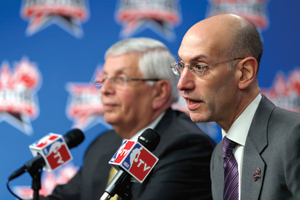 |
NBA Commissioner David Stern defers to his successor, Adam Silver, about who will host the 2015 All-Star Game.
Photo: GETTY IMAGES
|
So we’re starting to see the foundation of an Adam Silver-led NBA, and one area where he will make his mark is in selecting future sites of the All-Star Game. One of his first decisions will have interesting ramifications in the New York market, specifically: Who will host the 2015 All-Star Game? Both Madison Square Garden and Barclays Center have bid for the game, and Silver said that one of them will win the bid. MSG will be done with its massive, $1 billion renovation by that point, while Barclays Center will be only 3 years old, and the NBA likes to showcase new venues. There is also the undercurrent of the cross-town rivalry between MSG Chair
Jim Dolan and Nets Chair
Mikhail Prokhorov, and continuing down the line to
Hank Ratner and
Brett Yormark, as well. These executives will do all they can to lobby Silver for the game, and the decision he makes on this point, likely a year away, will be fun to watch. Stern even said almost gleefully, “I think that Commissioner Silver is going to have a great time with those applications. I really do.”
Of course, talking about future All-Star sites, Stern had a little poke at the NFL in saying that Silver is “going to play it outdoors in New York.” But all kidding aside, the future “big-event strategy” of All-Star Weekend will be another topic on Silver’s to-do list. More than a few sources in Houston believe the weekend is in need of a revamp, and media reviews coming out of the event were tough — to be kind — on the Saturday night skills competition. The future of the weekend was clearly on Silver’s mind when he acknowledged that discussions have already been taking place. “We’ve discussed playing internationally, All‑Star Games. I’m not sure if it will work logistically, but it’s something we’ll continue to study,” he said. “We’ve looked at other neutral cities. We’ve looked at refreshing All‑Star Saturday Night and other innovative events for the weekend.”
■ The big issue before Silver will be leading the decision on jersey sponsorship. This will happen, but one new aspect that was mentioned by more than a few team executives was the question of whether they have the sales experience necessary to sell such complicated inventory. That is certainly part of the discussion when the debate comes to whether the league or teams should sell the inventory.
n The move by the National Basketball Players Association to remove Executive Director Billy Hunter was the right one. There have been too many questions about Hunter’s leadership for him to continue and, frankly, players deserved better. But the question now becomes, Who drives the change, and what does the change look like? The role of the game’s top agents during a change of leadership in any players association is closely monitored, as they wield great influence in telling clients what type of leader is needed. I found the answers from two such agents in recent interviews to be revealing. Both David Falk and Arn Tellem look for executives who can work with the league to increase revenue during a time of labor peace, but they also see leaders from different backgrounds.
Falk told USA Today, “When I hear some of the names being bandied about — former agents or former players — that’s not remotely what the players need right now. The players need almost a corporate executive who got hired to increase the sales of a company, who can come in and work with the league to exploit new income streams.” But Tellem offered a different view, telling SportsBusiness Daily: “A profound knowledge of labor law is, of course, essential. The director has to be masterful at internal politics, like an old congressional hand who is adept at mollifying fractious constituents. Most importantly, the union’s executive director must educate, unify and motivate the players.”
So a corporate turnaround strategist and rainmaker, or a politically skilled diplomat? And are they mutually exclusive? No timeline has been given on when a decision could be made, but it’s a rare opportunity for a new commissioner and new executive director to work together at building a relationship while expanding the game.
■ A highlight of the NBA Tech Summit was a one-on-one with Twitter CEO Dick Costolo and CNN’s Soledad O’Brien. Costolo is a lean-in, excitable, engaged speaker whose passion for his product is clearly evident. One takeaway for me — as I am a voyeur but not a poster on Twitter — Costolo’s focus on showing new users just how indispensable the service can be.
> LEADERSHIP AT THE NCAA: Outside of the NBA All-Star Weekend, I’m getting more and more questions about the leadership of the NCAA, and it’s fair to say that Mark Emmert hasn’t had the best start to the year. Last week’s termination of Vice President/Enforcement Julie Roe Lach over the botched investigation at the University of Miami led to numerous calls for Emmert’s resignation. That’s not going to happen. But make no mistake about it: There is serious unrest in the ranks of collegiate sports with the current leadership, especially when it comes to enforcement. This embarrassment over the Miami case only heightens the pressure on Emmert. Lach was well-respected within the collegiate world, and she was promoted by Emmert when he first joined the NCAA. She’s being viewed as the person taking the fall for an issue that was seen to be mishandled at the highest levels.
There’s been a lot of turnover under Emmert — on the operations and business side, and now within enforcement and compliance. Some believed the new faces were needed, but it’s caused a great deal of unrest among member institutions and business partners. I’m not ready to give up on Emmert. I like him and grew more enthusiastic the more time I spent with him. He’s tried hard to change the system and the model of NCAA oversight, which we all know to be flawed. He said time and again he wants to reform the rules and the enforcement process. It’s been one of his strongest pledges over the last two years.
People point to the fact that if he truly was unaware of the methods being used to gain information in the Miami case, then he wasn’t paying enough attention to an area that he’s identified as critically important and in need of change. He’s seen as not being accountable to some of the organization’s key decisions. I believe he must change the way he’s leading, or I’m concerned that more mistakes and questions regarding his handling of the next big issue may put Emmert’s standing with the NCAA Executive Committee, and its Chairwoman Lou Anna Simon, in peril.
Abraham D. Madkour can be reached at amadkour@sportsbusinessjournal.com.