 |
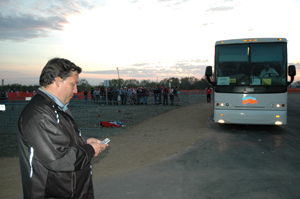
Geoff Moore covered a lot of ground to ensure the U.S. Grand Prix ran smoothly.
Photo by: TRIPP MICKLE / STAFF
|
Early on Nov. 17, long before the first Formula One cars hit the track for qualifying at Austin’s new Circuit of the Americas, Red McCombs took a seat for a brisket hash breakfast in the Texas Capitol with 40 sponsors, business partners and prospective clients of Austin’s new racetrack and told the history of how motorsports’ most affluent and international racing series had come to Texas.
“This was the hardest sell to the banks I’ve ever had,” McCombs said of the $400 million, 3.4-mile track outside Austin that brought Formula One racing back to the U.S.
“My youngest daughter, she’s 53, she came to me and said, ‘Do you realize that when the first race happens you’ll be 85. Don’t do it. You’re going to lose all your money.’ I said, ‘Well, I’m not spending my money. I’m spending yours.’”
Everyone at breakfast laughed. Everyone except Geoff Moore, who was seated across the table from McCombs.
Moore, the Circuit of the Americas chief revenue and marketing officer and a man McCombs calls “a great salesman,” usually loves hearing McCombs speak, but on this morning his mind wandered. It was the beginning of a make-or-break 36 hours for the Circuit of the Americas. More than 200,000 fans were expected over the next two days, and the quality of their experience would go a long way to determining if they would come back.
 |
The inaugural race drew more than 117,000 to the new circuit.
Photo by: GETTY IMAGES
|
The sports industry is littered with first-time events gone wrong. From Austin, all you have to do is look up Interstate 35 to Dallas and think back two years to the Super Bowl for an idea of how disastrous they can be. It took some fans more than two hours to clear security that day, and once they did, some found that their temporary seats didn’t exist.
Everyone involved in the Circuit of the Americas project knew they couldn’t afford similar negativity. With F1, they were importing a global sport that had failed in the U.S. so badly that it hadn’t even held a race here since 2007. The overwhelming emphasis from McCombs to Chairman Bobby Epstein to President Steve Sexton to Moore was on providing a great customer experience. It was the only way they could guarantee fans would return to the $400 million facility.
Moore knew the situation all too well. He worked for the Dallas Stars for 18 years and was on the team’s staff when it opened American Airlines Center in 2001. A long line for the bathroom. A sign directing fans to the wrong place. A shuttle bus line that didn’t move. Any of those could make selling tickets to future events tough.
“There’s a tipping point,” Moore said, “and if you cross it, people won’t come back.”
■ ■ ■
Moore’s inaugural F1 race weekend started with a bad break. Literally. Early on Saturday morning, two hours before breakfast began at the Texas Capitol, the wife of his vice president of marketing called. She sounded upset.
“Have you heard from Regan?” she asked.
The last time Moore saw Regan Holley was at 1 a.m. when both he and Holley, the executive who was going to manage merchandise sales during race weekend, were wrapping up final preparations for Saturday’s event. Moore hadn’t heard from him since they both left.
“He was in a car crash this morning,” Holley’s wife said. “He’s OK but he’s in the hospital. He broke his arm.”
Moore was going to have to assume his duties.
Later, as he waited for a helicopter to get him to the track after the sponsor breakfast, Moore leaned against a wall of a downtown hotel and sent a series of text messages to let people know he would be handling merchandise. One of the replies he received caused him to grimace. Circuit of the Americas misread demand and already was running out of product. Though things seemed to be going
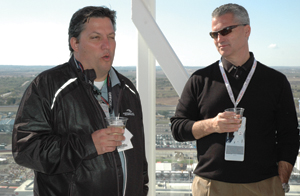 |
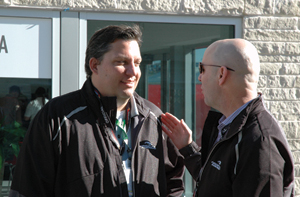
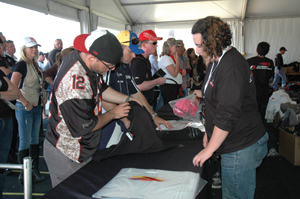
Race day with Geoff Moore: Top photo, chatting with McCombs Enterprises partner Bruce Knox; middle, a packed merchandise tent; and a champagne toast with sponsors.
Photos by: TRIPP MICKLE / STAFF
|
sideways early, Moore was unfazed.
“We’ll handle it,” he said, shrugging. “Is there any other way?”
Once he reached the track for Saturday’s qualifying, Moore focused on merchandise. He received a text around noon that merchandise lines were so consistent and so deep — six to eight people at all times — that cashiers weren’t able to break for lunch as planned. Temp employees working the three merchandise tents were hungry.
Moore reached out to Sodexo, the food provider for the facility, to see if they could make sandwiches on short notice. When Sodexo said no, he drove a golf cart a quarter-mile to a nearby Exxon Mobil and spent $400 on chips, energy bars, candy bars, soda and drinks for the staff.
“We had to keep the people alive because they’re in the merchandise gulag now,” Moore joked after he delivered the food to the three tents. “It’s like prison. They’re locked inside those merchandise tents.”
The high demand for race apparel was good news. It looked like they would surpass their goal of $1 million in merchandise sales. The bad news was some customers might leave without being able to buy what they wanted. Later in the day, Moore got a call at 4 p.m. at the helipad where he was waiting for a chopper to take him back to town for a sponsor dinner. Helicopters ascended and descended behind him as he paced back and forth with one hand pressing the phone to his left ear and the other covering his right ear. He looked distressed.
In all the lead-up to the first-time event, Moore had underestimated demand. Now word had come that the merchandise provider, PXP, had already run out of some T-shirts.
“Now I’m the idiot who didn’t order enough merchandise,” Moore said after hanging up. “We have to sell everything we got. I hate it.”
■ ■ ■
A year ago, it looked like Austin might not get its F1 race. Epstein and McCombs had fallen out with partner Tavo Hellmund, who had a contract for the race, and needed to close a new, 10-year agreement with F1 CEO Bernie Ecclestone. Construction was halted and the entire project was in limbo until early December when a new deal was secured. That left the track with 11 months to finish construction, sell tickets and find sponsors.
Just a week before the race there was still a lot to be done. Team hospitality suites weren’t built. Sod hadn’t been put down. Wood chips hadn’t been spread over pedestrian walkways. Offices for F1 officials still had exposed wiring and no furniture.
But as fans began to stream into the track shortly after 7 a.m. on race day, Nov. 18, no one could tell. Moore arrived that Sunday around the same time as the first fans, and there was already an issue waiting for him.
The University of Texas band was supposed to board 11 buses and head out to the track to play as part of the pre-race show, but they didn’t have the credentials they needed to get the buses into the facility. He and the track’s event staff scurried to find the credentials the band needed.
He broke away to the paddock where F1 teams prepare their cars around 9:30 a.m. It wasn’t long after he walked into the paddock that Ian Burrows, director of F1 Racing Group at Haymarket Consumer Media, walked up to Moore and beaming, slapped him on the back.
“Slam dunk,” Burrows said. “Absolute slam dunk. Twenty-two minutes from the downtown Hilton to the paddock is just amazing. It’s Melbourne meets Montreal. From fans to sponsors to media to journalists, everyone is in love. This is going to be one of the signature races.”
“Talk to me after we get 120,000 people out of here, and I may feel the same way,” Moore responded.
Getting fans home after the race was the issue of the day. In its agreement with the city, the track promised that it would provide a shuttle service to get most spectators to the track, and it limited parking to 17,000 cars. Circuit of the Americas and its transportation agencies — TMS, Kimley-Horn and Associates, and Vasta & Associates — had spent more than a year designing a bus plan that could shuttle 100,000 people from the track in a span of three hours. It was the issue everyone was watching, and it was in the back of Moore’s mind all day.
■ ■ ■
By the time the race began at 1 p.m., no unexpected issues had popped up, so Moore grabbed a golf cart and circled the track, checking on the merchandise tents and compiling a list of things that could be improved. He saw a woman struggling to push a man in a wheelchair and noted that disability access needed to improve. He drove past an exposed, dusty bowl that looked like a sinkhole near a concession stand and decided something needed to be done with it aesthetically. He picked up an elderly man struggling to climb a steep hill and listened to the man’s one word of advice.
“This thing would be perfect if they just had shuttles between the turns,” the man said.
“I’ll have to talk to someone in charge about that,” Moore said.
After he dropped the man off at the top of the hill, Moore headed toward the paddock for the final laps of the race. He wanted to be available in case any F1 and team officials had any complaints. But no one had any problems,
so he took a deep breath, hopped into a car and went to check on the shuttle buses.
The plan was to have 530 school, charter and city buses ferry people from the racetrack to three different locations — the expo center, downtown and the airport — after the event. The goal was to have 45 buses leave every 10 minutes, taking 13,500 people to their cars every hour.
But when Moore arrived at the shuttle area at 5 p.m., that wasn’t happening. It was two hours after the race ended, and there were still long lines to leave the facility. People boarding buses had waited an hour and a half. Some were miserable. Some were OK.
Moore was nonplussed. At other Formula One races, it can take four hours for spectators to get home. By that standard, an hour and a half
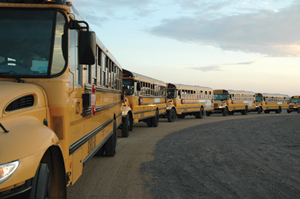 |
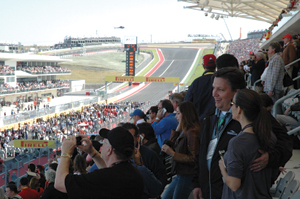
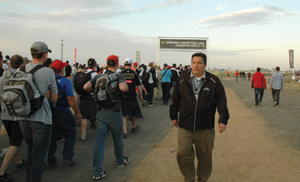
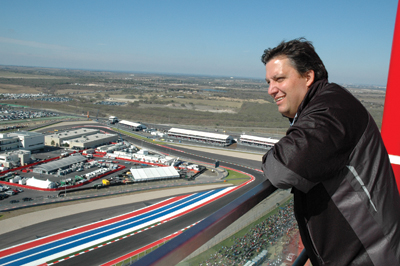
More of Moore’s day: He enjoys part of the spectacle from the grandstand (top photo) and then deals with the logistics of getting 117,000 people home after the race, which required coordinating 530 buses.
Photos: TRIPP MICKLE / STAFF
|
to two hours was excellent. But there’s a different expectation among U.S. sports fans, and Moore knew they were beginning to push it.
“Home, home,” Moore said, wrapping his hands behind his head and looking at the crowd. “Come on. Let’s get them home with the good stuff fresh in their mind.”
A half-hour later, the lines had thinned to nothing. People were walking straight to the front and boarding buses. Moore was relieved. He climbed into his Audi Quattro and headed back to the track. Race day was done.
More than 117,000 people had come and gone that day without any major issues. Sure, the facility had run out of merchandise and champagne. And yes, cell service was spotty. But the race was praised by almost everyone.
Everyone except Moore. As he drove back to the track that evening, he said that Circuit of the Americas got a free pass this year. The weather was great, and everyone knew they had built the track in less than a year.
This year, the staff handled it. Next year, the expectations will be different.
“When they come back, they’ll expect better,” he said. “And we’ll have to give better.”