No. 2
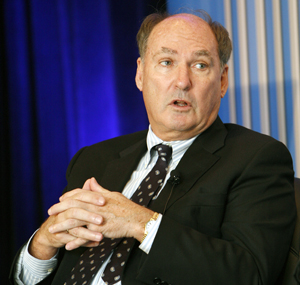
Jim Delany
Big Ten commissioner
If the SEC’s Mike Slive got everything he wanted in the new playoff format, it was only because Jim Delany allowed it. Delany for many years was considered the roadblock that stood between college football and a playoff. He staunchly stood up for the bowl system, especially his conference’s traditional tie to the Rose Bowl. Only when he relented did a playoff become a reality.
“He’s tough, and he doesn’t mince words. And he has earned the right to speak,” Michigan President Mary Sue Coleman
 |
| Photo by: Shana Wittenwyler |
said of Delany. “For the record, I was not an advocate for a playoff. But I saw reality and what was going to happen,” and so did Delany.
Not that Delany was a loser in the playoff talks. He maintained the Rose Bowl connection with the Pac-12 and, in the playoff scenario, he was a strong voice in favor of having an NCAA-like committee select the four best teams. He wanted “the eye test” that only a selection committee can offer.
While it took time for Delany to shift positions to favor a playoff, he has been much more of a leader than a follower in just about every other regard. The conference’s launch of the Big Ten Network in 2007 was a game-changer in every sense. It also was Delany’s look into conference expansion in December 2009 that triggered an almost chaotic conference realignment, with everyone reacting to the Big Ten.
“He’s the leader in his field,” said Ohio State Athletic Director Gene Smith. “His influence is significant because his understanding of college sports, particularly college football, is so good. He’s always ahead of the curve, always looking down the road, and that’s why he usually knows what’s coming before anyone else.”
No. 3
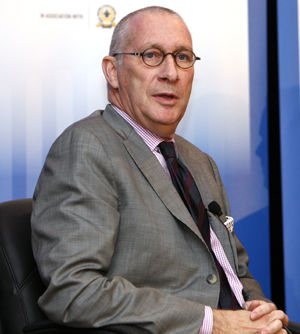
John Skipper
President, ESPN
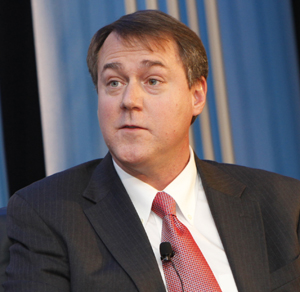
Burke Magnus
Senior VP, college programming, ESPN
 |
John Skipper
Photo by: Shana Wittenwyhler |
 |
Burke Magnus
Photo by: Shana Wittenwyler |
When ESPN decided to pay $80 million a year for the Rose Bowl, it was clear that the network considered the college football postseason important. When it followed up that deal with another $80 million-a-year deal for the two-month-old Champions Bowl, it was clear that ESPN wanted to own the college football postseason. Fox still is expected to bid on the BCS games, but ESPN is the clear favorite to land them.
With Skipper’s direction and Magnus’ deal-making, ESPN has become the home for college football. It holds more media rights than any other media outlet, including deals with the top conferences. It has deals with the University of Texas for the Longhorn Network and has been kicking the tires with the SEC on a conference channel. It also has more outlets to carry programming than other media companies, including a dedicated college sports channel (ESPNU), a broadband site (ESPN3) and a mobile application (WatchESPN).
ESPN denies criticism that it was the driving force behind conference realignment, which created upheaval in college sports the past two years. But the mere fact that industry veterans believe ESPN has that kind of power underscores the influence it has in the college sports landscape.
No. 4
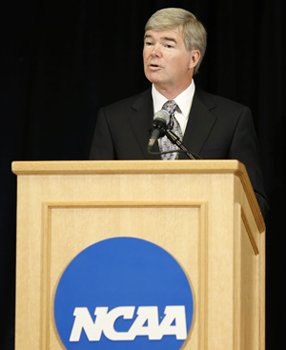
Mark Emmert
NCAA president
Emmert doesn’t consult with conference commissioners on which teams they should invite, he doesn’t negotiate TV
 |
| Photo by: Getty Images |
deals and he had no say in the new college football playoff system. Throughout much of the past two years, it would be easy to conclude that Emmert has little to no influence in college football. That changed, however, on July 23, when Emmert announced some of the harshest penalties ever levied against a school. Penn State faces scholarship limitations, recruiting restrictions and a $60 million fine in the aftermath of the Jerry Sandusky scandal. While industry observers and athletic directors debate whether Emmert overstepped his bounds with the penalties, the sanctions delivered a stern warning: Cheaters and bad actors will be dealt with swiftly and severely under his watch.
In the days after the penalties were announced, Emmert was called the NCAA’s new disciplinary czar and some compared him to the kind of commissioner that pro leagues have. “You’re going to see an NCAA president who is more empowered than any of the presidents before him,” an industry source said. “He’s going to be a major force.”
No. 5
Larry Scott
Pac-12 commissioner
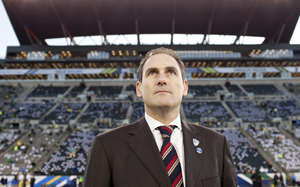 |
| Photo by: Pac-12 Conference |
No commissioner has wrought more change in the last few years than the Pac-12’s Scott. Just last week, six new conference regional networks and a national network launched for a conference that only five years ago was an afterthought on the national scene. Scott’s three-year tenure has seen the Pac-12 add Colorado and Utah, create a conference championship game, negotiate a record-breaking TV deal with ESPN and Fox, start networks and launch a plan to expand the Pac-12 brand into Asia. Everyone, whether they work in college football or not, is watching to see what Scott is going to do next.
Not everything has been golden out west. Scott was the last man standing among the commissioners, curiously favoring a “plus-one model” over the four-team playoff that won out. And his bids to expand with Texas and Oklahoma didn’t pan out. But as the Pac-12 moves into a new era with TV networks, a mega-rich media contract and a renewed cool factor, such setbacks are getting harder and harder to remember.