While the first Stanley Cup Final between the Los Angeles Kings and the New Jersey Devils gives the NHL’s biggest series extra importance in the country’s biggest markets, it’s unclear how much the sport’s labor uncertainty might undercut any new momentum.
Industry speculation for months has been that the league may seek the kind of significant fiscal changes that could lead to a work stoppage this fall. The NHL CBA expires Sept. 15, but the two sides have not met and will not until after the Stanley Cup is awarded.
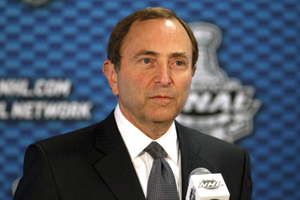 |
NHL Commissioner Gary Bettman said he expects formal bargaining to begin in a few weeks.
Photo by: GETTY IMAGES
|
NHL Commissioner Gary Bettman briefly expressed frustration over the topic of a potential work stoppage during his news conference before the first game of the Stanley Cup Final. “I don’t understand all the speculation and negativity,” Bettman said.
Unlike past labor negotiations involving the biggest team sports in North America, in which the chance of a work stoppage was telegraphed years in advance — most recently in the case of the 2011 NBA and NFL lockouts — the NHL and the NHL Players’ Association have not given a lot of advance notice. Neither side has revealed what it will ask for at the table when talks do begin. Bettman said last week that he expected formal bargaining to begin in the next few weeks.
Although Bettman was brimming with optimism on the eve of Game 1, NHLPA Executive Director Don Fehr, who has been through labor strife in his 25 years as former head of the MLB players union, was more cautious when asked about the chance of the 2012-13 NHL season starting on time. “All I can say is that I certainly hope it does,” Fehr said after Bettman’s news conference, which he attended. “That’s the goal. It’s a goal I hope everyone shares.” Fehr noted that he’s learned not to try to predict what might happen in a labor negotiation.
Still, most NHL executives seemed to take a “What, us worry?” attitude during the Cup Final, which moved to Los Angeles for Game 3 today. “There is no reason that the current collective bargaining situation could or should impact the Stanley Cup Final in any way,” NHL Deputy Commissioner Bill Daly said in an email last week.
For months before the 2004 Stanley Cup Final, there was a feeling of doom about a lockout. The NHL had hired former SEC Chairman Arthur Levitt, who proclaimed in February of that year that the league’s business was broken and team owners had lost $273 million the season before. In the two years leading up to that lockout, NHLPA Executive Director Bob Goodenow had been telling players in team locker rooms to save their paychecks and prepare for a prolonged work stoppage. But that was back then, when league revenue was about $1.5 billion.
In the eight years since, the NHL has enjoyed rapid growth, with NHL revenue topping $3.3 billion under the new system. It’s built on the first-ever salary cap, which the owners had demanded and received, after a lost season.
“I think it is difficult to compare where we are today to the situation we faced in 2004,” Daly said. “The game, the business and the industry are a lot different now than they were then.”
He did not reveal what position the owners will take when they begin formal bargaining with the players for a new CBA this summer.
However, there has been growing speculation in the media and within the industry that NHL owners will seek the same kind of reductions in the players’ share of revenue that the NFL and NBA owners sought and to some extent received, which led to lockouts in both sports in 2011. NHLPA officials have said the players are not in the mood to make givebacks after the 2004-05 lockout. The uncertainty presents a challenge to NHL franchises looking to renew season-ticket, suite and sponsorship accounts during the summer, without the guarantee of a season starting in October.
On May 16, the NHL served notice to the NHLPA that it would terminate the current CBA when it expires Sept. 15. Under the CBA, either side had to file such a notice 120 days before the expiration if it wanted any changes to the current deal.
“Had no notice been given by either party, under CBA Article 3.1(a) the CBA would have remained in place for another year,” Fehr wrote in a letter to players and agents last month.
The NHLPA would not comment on the letter, a copy of which was obtained by SportsBusiness Journal, but at least one agent took Fehr’s statement to mean that players would have been happy to continue under the current system for another year, had the NHL not served notice.
Some hockey sources see the 120-day notice, and the fact that the NHL in March canceled plans to open the 2012-13 season with the “Premier Games” in Europe, as the league has done for the past five years, as signs the NHL is preparing for a lockout.
A few teams were said to be considering the cancellation of their summer training camps for prospects. The Young Stars Tournament, which has been held in Penticton, British Columbia, for the last few years as a rookie showcase for the Edmonton Oilers, Calgary Flames and host Vancouver Canucks, was canceled last month because of labor uncertainty.
And there has been speculation that the Traverse City tournament, a rookie camp and round-robin in Michigan for eight of the NHL’s clubs which is held in early September, would be canceled as well.
“For now, we’re proceeding like it’s going to happen,” said one hockey operations executive whose team is a perennial participant at Traverse City. “Ultimately, the Red Wings will make that call.”
Rick Bowness, public relations coordinator for the Detroit Red Wings, who run the annual event, said the tournament is going ahead as planned. He did not say whether the tournament would go forward regardless of labor developments.
Daly told SportsBusiness Journal last month that the clubs, not the league, make the decisions on whether to hold rookie camps and tournaments.
Although league and union executives will not speak on the record about what they want in a new CBA, some expressed optimism about the process. Some agents were not as optimistic.
“There have been a series of events, including the cancellation of one rookie tournament, that leads one to believe the league is preparing for a lockout,” said Ian Pulver, an NHL agent and former associate counsel of the NHLPA. “The league’s actions do not make sense, especially against the backdrop of record-setting revenues and magnificent coverage of the game from New York to Los Angeles. I am certain that Don Fehr will prepare the players accordingly.”