Akey developer for
AT&T Park in San Francisco says the Golden State Warriors have picked the right time to build a new arena in town.
The NBA team wants to construct a privately funded waterfront arena in the next five years, but there will be many political hurdles to overcome before it can break ground on the $500 million facility. To drum up support for the project, the Warriors can rally around two points, said Pat Gallagher, the San Francisco Giants’ former senior vice president of business operations.
In two years, the 49ers are moving to a new stadium under construction in Santa Clara, leaving a sports void to be filled in the Bay Area’s cultural center, Gallagher said. More important, San Francisco remains the nation’s largest market without a modern arena. Positioning it as a new landmark — “San Francisco’s version of the Sydney Opera House” — would help form a long-term vision for the project, he said.
“If you design it right and look at it, you know exactly where you are,” Gallagher said.
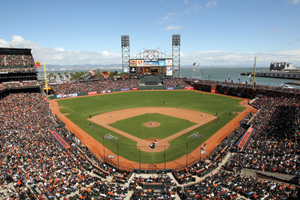 |
Pat Gallagher helped the Giants build a local classic, AT&T Park, and he thinks the Warriors can create “San Francisco’s version of the Sydney Opera House.”
Photo by: GETTY IMAGES
|
As the Giants pulled together plans for privately funded AT&T Park, Gallagher developed the Charter Seat License program, secured the park’s naming-rights deal with
Pacific Bell and signed other deals for the facility’s Coca-Cola Fan Lot and Old Navy Splash Landing. He created baseball’s first secondary ticketing program, Double Play Ticket Window, the forerunner to
StubHub. Later, as president of newly established
Giants Enterprises, Gallagher developed a special-events division to supplement the baseball side of the business.
“If enough people care about this [arena] project, it will happen,” Gallagher said. “Any big idea has to have the right players behind it.”
For the Giants, the right person behind the ballpark project was a pastor, not a politician. After four unsuccessful attempts at the ballot box to get a stadium finance deal approved with public money, the MLB team decided to pay for the $357 million park on its own.
Facing a fifth public vote in March 1996 tied to an exemption for waterfront height restrictions, the Giants used three high-profile community leaders to support their cause, including the Rev. Cecil Williams, a minister whose church ran a local soup kitchen.
The Giants surveyed city residents to find out which person was most trustworthy in their minds and Williams “came out No. 1,” Gallagher said. Williams volunteered his services and the vote passed, clearing the way for the Giants to build a new waterfront park that opened in 2000.
“The plan was to seek out the right opinion leaders to help us convince the community that this is the right plan,” Gallagher said. “San Francisco functions through a lot of community activism. There is a basic mistrust of wealthy people who come in with big ideas, and the key is getting the community to accept it.”
 |
Cohen
|
TIDBITS: Sports designer
360 Architecture, arena manager
Global Spectrum and
Consulting Merengue are consultants for developer
Chris Hansen as he pursues a privately funded new NBA and NHL facility in Seattle. The three firms are working on preliminary design and development for a new $480 million to $500 million arena after completing an assessment of
KeyArena operations, where a basketball and hockey tenant would play for two years while a new venue is built. Consulting Merengue’s
David Perez previously worked for
International Facilities Group, whose principals include
Michael Reinsdorf, president of the Chicago Bulls. …
Dave Cohen has left the Atlanta Falcons to start his own consulting company,
Cohen Consulting Group, with expertise in season-ticket sales, marketing premium seats and concessions. Cohen was with the Falcons for 10 years and most recently served as their vice president of sales and service. He also worked five years for the Portland Trail Blazers, and before that, with baseball’s Brett brothers in Spokane, Wash. …
Chris Bigelow is consulting for the Edmonton Oilers to select a food provider for their proposed $450 million downtown arena.
Don Muret can be reached at dmuret@sportsbusinessjournal.com. Follow him on Twitter @breakground.