Three years ago, Baltimore Ravens center Matt Birk tried a new helmet with a different type of interior cushioning system. Since then, he said, he hasn’t suffered a concussion nor even the normal headaches and wooziness that Birk says are commonplace in the game.
This season, up to 150 NFL players are planning to wear Xenith brand helmets, the 8-year-old company said. That’s more than three times last year’s number and a volume that would chip away at the dominance long enjoyed by Riddell, the official NFL helmet since 1990 and which has 70 percent of NFL players in its product.
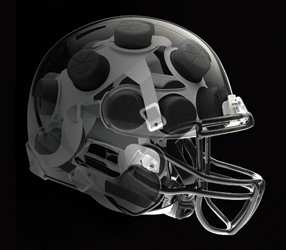 |
A look inside Xenith’s helmet technology
|
With on-field safety front and center in the NFL as it confronts a long line of former players suing the league contending that the game has permanently injured them, upstart Xenith and its shock-absorber technology could became a significant presence in the sport. Some of those lawsuits have named Riddell as a defendant.
“Riddell: They are the Coca-Cola of helmets; they are the McDonald’s. By default, most guys wear Riddell,” said Birk, who played collegiately at Harvard with the founder of Xenith, Vin Ferrara. “I try to be an advocate of player safety, and obviously it is tragic what has befallen the former players with brain trauma, so I am very excited about Xenith.”
Riddell scoffs at Xenith’s contention that its helmet, which has air capsules strung in a bonnet attached to the shell interior, is new.
“Any suggestion that Riddell’s technology is outdated is inaccurate,” said Riddell spokeswoman Erin Griffin. “Riddell patented throttled-air technology in the 1970s and tried, used and discontinued using it, and has since moved on to more effective, engineered designs.”
Throttled-air technology is what Riddell calls the system Xenith employs in which air capsules take in and breathe air in response to impact.
Ferrara, a former Harvard quarterback with business and medical degrees from Columbia University, founded the company in May 2004 after watching hockey player Eric Lindros suffer multiple concussions.
The first helmet reached the market in 2009, and 24,000 were sold in 2010.
“Personally, I don’t feel there is a lot of innovation with [our competitors’] helmets,” Ferrara said. ‘They are still relying on a concept of velcro attached to padding inside a shell. There was a gap in the marketplace, and we decided to pursue it.”
Company profile: Xenith
Founder: Vin Ferrara: former Harvard quarterback; Columbia MD and MBA
Business:
Largely makes football helmets, but branching into hockey and baseball helmets
Year founded:
2004
First football helmet sold:
2009
Football helmets sold in 2011:
65,000
Football helmets expected to be sold in 2012:
100,000
Sales, 2011:
$7 million
Expected sales, 2012:
$12 million
Source: Xenith
Last year, Xenith sold 65,000 helmets; it expects to sell 100,000 this year. There are roughly 1 million helmets sold annually in the U.S., with Riddell accounting for about half that and Schutt the nearest competitor in the market, largely comprising youth, high school and college players. Along with Xenith, Rawlings has also gotten into the business recently.
Xenith posted revenue of $7 million last year. The company expects to reach $12 million in 2012.
The biggest hurdle for the company is Riddell’s official deal with the NFL, an agreement that runs through 2013. Only Riddell’s name can appear on a helmet on an NFL field; any other corporate logo must be covered.
“That business relationship really prevents us from getting exposure,” said Jim Huether, Xenith’s vice president of marketing and business development. “Even though Ray Rice wears the helmet, the average parent or coach doesn’t know that.”
In 2010, the NFL’s head, neck and spine committee said the league should abandon its Riddell deal because having the deal implies that the company’s equipment is superior. Birk seconded that notion, saying that if the league is serious about health and safety it wouldn’t give privileged status to Riddell.
An NFL spokesman declined to address whether the league would allow all helmet brands onto the field after 2013.
Ferrara said Xenith helmets will not prevent all concussions, though he said the company’s limited internal research shows fewer concussions in their helmets than others. Given the past number of undocumented concussions, however, the reliability of such a contention is unclear.
For now, Xenith is relying on word of mouth largely from players like Birk, who said he also loves the helmet because it does not have to be tight on the head or pumped with air.
“Right away you feel a difference,” he said. “It seems to absorb the force of collisions quite well.”