The feedback loop originated as a concept to gather feedback about a product or a service after the product had been purchased or after the service had been provided. The initial purpose was to determine if the product or service was satisfactory, and if not, why not, leading to possible adjustments and corrections. Feedback along with product research and development became associated with the concept and terminology of new and improved.
The next phase in the development of the feedback loop was the idea of trial testing and getting feedback prior to the introduction or the offering of the product or service. This was designed to be a proactive approach to identifying issues and problems that might arise as well as to gauge the temperature of the intended target market with regard to the product or service being offered. Phase one and phase two feedback was most commonly based in product trial and observation, focus groups, surveys and, of course, sales results.
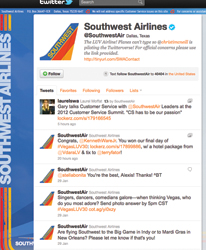 |
Southwest Airlines makes listening to customer feedback a priority.
|
In 2012, feedback is much more plentiful, but unlike phase one or phase two feedback, it is not necessarily controlled by the product or service provider, nor does it always originate with the provider. It is often organic, uncontrolled, unsolicited and not always fair or accurate. And, most importantly, it is influential because it is experientially based and provided publicly and freely from one consumer to, theoretically, the consumer universe. Feedback in the form of information and opinion is a core component of the Internet and the various forms of social media — blogging, tweeting and so forth — that consumers seek out prior to making a purchasing decision.
Unfortunately, in my experience with sports organizations, feedback usually doesn’t happen, and if it does, it is most often related to a specific incident that has been publicized and brought to the attention of management. The approach is lacking in terms of strategy, consistency and ultimately effectiveness in sports, yet is an important component for most businesses that provide products or services through both brick-and-mortar stores and online sites.
Want to test this out? Go to your Twitter account (hopefully you all have one) and mention the name of a business or even a personality in your tweet. If the organization has an effective strategy like the one I have been describing, you should receive a notification back in 24 hours or less that the subject or the mention in your tweet is now following you. In the past, I mentioned Orbitz and my dissatisfaction with their customer service in a tweet. Within two hours, I was being “followed” by Orbitz. Within four hours, a vice president of customer service from Orbitz contacted me, and my problem was addressed and resolved to my satisfaction.
Questions about
how feedback works
■ Who in the organization is responsible for MONITORING the Internet and social media feedback loops and collecting meaningful and useful data?
■ How is this information INTEGRATED with other feedback surveys, focus groups, unsolicited letters, calls and emails, etc.?
■ How is all of this feedback SHARED and with whom? How regularly does this occur?
■ How is the information ANALYZED and used?
■ How is the information generated from the feedback channels used in PLANNING AND DEVELOPMENT and refinement of the product or services being offered?
■ How are resulting changes and modifications COMMUNICATED to the public and target markets through traditional and social media channels?
■ Is there a way to address the social media feedback PROACTIVELY instead of just reactively?
The other day, I mentioned a Brad Paisley song in a tweet. Within two hours, I was being “followed” by Brad Paisley. (I am honored.)
Unfortunately, several months ago, I made some very strong comments about Delta Airlines and stated that I would never fly that airline again, and I have yet to be followed or get a response. Meanwhile, competitor Southwest Airlines has capitalized upon the customer feedback regarding baggage fees and launched an entire campaign promoting the fact that they listened to their customers and refused to follow that industry trend. Is it any wonder why Southwest continues to grow and flourish while other airlines struggle?
In March 2010, I wrote a column detailing the success of a Crispin Porter & Bogusky ad campaign for Domino’s (SportsBusiness Journal, March 8-14, 2010, issue). That campaign dramatically changed the financial fortunes of the company because it demonstrated its willingness to change and showed the actual changes that resulted from customer feedback. Domino’s showed that not only was it aware of the feedback, but it also was responsive, caring and effectively able to change.
What should sports organizations do? There are several effective ways to gather the data and information that can be used independently or in conjunction with one another to gather the information we have discussed.
■ Hire a social media tracking service that gathers and collates and provides an evaluative feedback regarding what is being discussed on the Internet regarding your products, services, personnel, policies or whatever. Socialmedia.biz offers a list and analysis of 20 such vendors and their capabilities.
■ Employ a social media coordinator or intern who not only monitors but also proactively disseminates positive information or responses that have been approved by the digital strategy director (SportsBusiness Journal, Aug. 15-21, 2011, issue). The organization can purchase social media tracking software to monitor Facebook, Twitter, LinkedIn, blog posts and articles.
There is an axiom dating from the 16th century stating that to be forewarned is to be forearmed. To have warning or knowledge about something is an advantage. In 2012, I would update this to state that to be forewarned is to be four-armed, and those four arms are social media, traditional media, community relations and public relations working together to provide the best defense as well as the best offense with regard to the best use of feedback.
Bill Sutton (wsutton@bus.ucf.edu) is a professor and associate director of the DeVos Sport Business Management Program at the University of Central Florida and principal of Bill Sutton & Associates. Follow him on Twitter @Sutton_Impact.