When the ink dried on the contract that sent the Atlanta Thrashers to Winnipeg this past May, the club’s new ownership group, True North Sports & Entertainment, was faced with a long list of tasks and a compressed schedule to accomplish them. True North had to sell NHL hockey back to a community still upset from the disappearance of its beloved Jets in 1996, it had to boost its operations and infrastructure to accommodate NHL requirements, and it had to create national partnerships to take the brand to Canadians at large. Staff writer Fred Dreier caught up with True North President Jim Ludlow to talk about the task of getting the Winnipeg Jets off the ground before the puck drops to open the NHL regular season on Oct. 6.
■ How long has your organization been discussing bringing the NHL back to Winnipeg?
Ludlow: The thinking really goes a long way back to the loss of the original Winnipeg Jets in the mid-1990s. I would argue Winnipeg was a much different community at that time. So fast forward a decade, and we developed the idea for building a state-of-the-art sports and entertainment venue here. That was a big issue why the team left in 1996. So the
 |
idea of building a new venue came back when our company bought the [AHL] Manitoba Moose from the company that was once called Manitoba Enterprises. We were able to position ourselves in the community’s private sector with this “maybe someday” idea for the arena, and we got it built [in 2004]. Now since then, we’ve had reasonable success with the Moose and our other entertainment offerings. Our position was that if the opportunity would arise, we would try to make this an NHL city. We took that project a lot more seriously in the last 36 months to develop financial modeling around an NHL operation.
■ You said Winnipeg is a different city than it was in 1996. What factors changed that enabled you to bring the team there?
Ludlow: Winnipeg has always been a dynamic place but it didn’t have the corporate strength just materialize like in Ottawa. Winnipeg is about stability and diversity. It’s grown. Now there are more corporate offices here than in Edmonton. MTS is here. And hockey has grown. We have a brand that is more able to capture the national sponsorship market than before, so we’re able to do a lot more with an NHL team than they could do in 1996. You layer in the strength of the Canadian dollar and the weakness of the U.S. dollar. I don’t know if we would be having this conversation half a dozen years ago when we had 70 cents on the U.S. dollar.
■ Why did you pursue the Atlanta Thrashers as opposed to the Phoenix Coyotes?
Ludlow: We were working with the NHL, and it was understood that when we had an opportunity it would be
 |
TRUE NORTH SPORTS & ENTERTAINMENT
The last 90 days have been a blur for Jim Ludlow as the Jets have prepared for the season. |
directed by the NHL. Solutions surfaced in Phoenix from time to time. The position of the NHL was obviously to remain loyal to the [Glendale, Ariz.] marketplace. So the situation arose in Atlanta for a more logical opportunity, but I think it could have just as easily been Phoenix.
■ What time frame were you looking at for getting the organization ready for NHL hockey?
Ludlow: We had to do in 90 days what you would typically expect to do over a 12- to 18-month period, not the least of which was create a new logo and jersey design. That conversation alone can be 18 months. The advantage we had is that this is an existing operation. Our AHL team was a significant attendance and revenue generator, so we could plug and play to a certain extent with sponsors and the building. Our staff has gone from 120 to 170 people, and most of the new staff is on the hockey operations side. We hired a new general manager. But it has been extremely intense.
■ Why did you choose to align yourself with the old Jets name as opposed to launching a completely new brand?
Ludlow: We had always debated whether to use the Jets or the existing Manitoba Moose name, and a lot of us had spent a lot of time building traction with the Moose brand. We were sad to see that go. Some people felt that Winnipeg had already seen the Jets, the Moose were off to Newfoundland, so let’s start fresh on a new brand. But there was a lot of passion for the Jets name, not just in Winnipeg but around Canada. We felt the best way to capture that national passion was to go with the old name and then develop a new brand with new logos and colors.
■ At 15,000 seats, the MTS Centre is one of the smaller arenas in the NHL. Will you be expanding?
Ludlow: No, the building was sufficiently sized from the get-go. Frankly, when we built the arena in 2004 we had the notion that we would never expand past 15,000. We wanted a building that could adequately hold 10,000 for AHL games and expand to 17,000 for concerts. So 15,000 is small for the NHL, but our season-ticket size is pretty high. The drive to 13,000 [season tickets] validated our decision. We scaled the arena from $39 to $129, and in this marketplace we felt that is a sweet spot. And our season-ticket agreements are all multiyear terms — it’s either a three-, four-, or five-year term, and we’ve sold out all of our season tickets for longer terms. If we had 18,000 or 20,000, that might be tougher to achieve what we’ve achieved. When there is always an available ticket for your games, the notion of demand is diminished.
 |
GETTY IMAGES
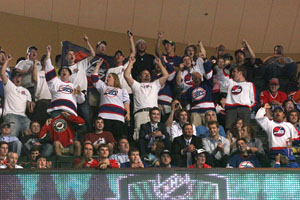
Jets fans made it clear at the NHL entry draft that they are ready for some hockey. |
■ What renovations and construction have you done to the building?
Ludlow: We did some significant upgrades, and we spent the summer and many millions of dollars doing it. We really improved our concessions and broadcast services, and there was significant upgrade to our ice plants and fiber optic capabilities. Our suites were also on the large side; they sat 24 or 25 people. So we’ve divided those and gone to 56 suites now. Otherwise, the building’s footprint hasn’t changed.
■ How has the value of the sponsorships increased?
Ludlow: As a typical multiple, it’s been three or four times to have a partner in the building now than before. We’ve tried to make that transition easier, and most of the partners have wanted to stay with us. They understand the metric is bigger, because some of them have relationships with the NHL teams in Ottawa or Edmonton. So the conversation has generally been pleasant.
■ What will your sponsorship portfolio look like?
Ludlow: MTS is our No. 1 sponsor, the local telecommunications company for Manitoba. They have been our naming-rights partner since the beginning, and they extended with us now for the next 10 years. After MTS we have 15 top-tier national sponsors that have also had previous relationships with us, like Labatt, Coca-Cola and Toyota.
■ What are examples of partners that you would not have been able to get with the Manitoba Moose?
Ludlow: In the financial services world we have a partner with a significant scale in Scotiabank. They are significant to have a national partner in the category, not just the financial value. We had financial service partners with the Moose but we could not extend that category into national scope because we did not have the kind of broadcast relationship. We are coming from a spot where we had little broadcast exposure to a full 82-game national broadcast exposure. And we have a 10-year regional and national deal with TSN for all of our home and away games. They are going to brand a TSN Jets channel in Winnipeg, which aligns us with what they have done in Montreal. I think we’re very fortunate to be in the same company with that brand.