MLB Commissioner Bud Selig often likes to trumpet baseball’s revenue sharing and its importance in improving the game’s on-field competitive landscape. In a general sense, that much is true, and the $405 million being shifted from high-revenue clubs to low-revenue teams in 2010 was up from zero prior to 1996. But the total still represents less than 6 percent of the $7 billion of total industry revenue generated in 2010, and even that fractional percentage remains a sore subject among some clubs.
The language in the current collective-bargaining agreement calls for revenue-sharing recipients to use the money to “improve [their] performance on the field,” and more generally, the plan is designed to “promote the growth of the game and the industry on an individual club and on an aggregate basis.”
That’s a large gray area, and wide interpretations have emerged over the past four years in which various clubs have suggested that those funds could be used for not only major league payroll, but areas such as minor league operations, overseas player academies, ballpark development and debt retirement. A continued divergence of opinion on how improving performance on the field should be defined has created not only a management-labor debate, but one within the owners as well.
 |
GETTY IMAGES
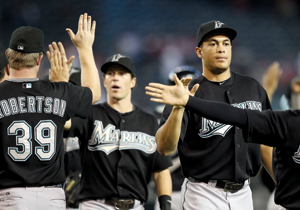
Last year the league and MLBPA struck an accord with the Florida Marlins in which the club agreed to boost its payroll. |
Selig has steadfastly insisted that club use of revenue-sharing money is regularly screened and reviewed. But early last year, the league and the MLBPA quietly struck an accord involving the Florida Marlins in which the club agreed to boost major league payroll while its new Miami ballpark was being built, addressing union concerns of misuse by the Marlins of revenue-sharing funds.
“You can’t disentangle revenue sharing from collective bargaining, and fortunately we haven’t done that. It goes directly to how players are compensated and how the industry functions,” said Michael Weiner, MLBPA executive director. “So, this issue, and the use of the funds, will be on the table. The funds are supposed to help make teams more competitive. The question here, much like many other issues, is how can we do it better?”
Beyond the management-labor dynamic, there is of course the owner-versus-owner one. Some high-revenue clubs, particularly the Boston Red Sox and New York Yankees, have echoed many of the union’s traditional concerns about where revenue-sharing monies are going, particularly as a leak of financial records for several low-revenue MLB clubs last summer on Deadspin.com showed hefty operating profits.
Red Sox owner John Henry disclosed recently that he was fined $500,000 last year by Selig for making critical remarks about the current revenue-sharing system. The offending Henry comment in question: “Over a billion dollars has been paid [historically] to seven chronically uncompetitive teams, five of whom had baseball’s highest operating profits. Who, except those teams, can think this is a good idea?”
Yankees co-chair Hank Steinbrenner recently went even further, likening the current system to “socialism, communism, whatever you want to call it, it’s never the answer.”
But as baseball’s competitive and fiscal balance has improved and disparities lessened, the revenue-sharing system actually showed a slight decline in 2010, falling from $430 million in net transfers in 2009 to the $405 million last year.
“The system works in both directions. It’s important to remember that,” said Rob Manfred, MLB executive vice president for labor relations and human resources. “This topic will be an issue. Some clubs are definitely interested in reforms, so the important thing for us at the league is to balance all the various interests.”
Transfer station
|
MLB had no revenue-sharing policy until 1996. It has continued to grow in the years since then, before dipping back slightly in 2010. Here’s a look at net transfers over the past four years:
|
YEAR
|
AMOUNT
|
2010
|
$405M
|
2009
|
$430M
|
2008
|
$409M
|
2007
|
$353M
|
Source: Major League Baseball