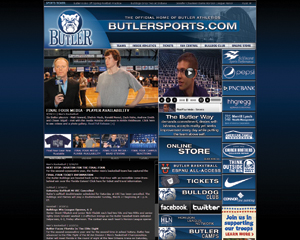
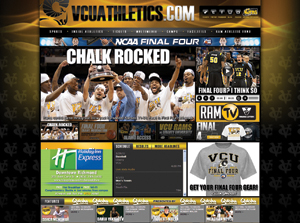
Butler and Virginia Commonwealth wore the slippers to the Final Four, but it was their website partner, little-known PrestoSports, that was the real Cinderella.
With a modest operation of 22 employees based in Rockville, Md., the small tech firm seldom competes against the giants in the college website industry, CBSSports.com College Network and NeuLion, which own the digital rights to most of the BCS schools. Instead, Presto has been happy to collect the rights to NCAA Division II and III schools, as well as a growing list of midmajors like Butler, VCU, Harvard and Yale, by offering a more cost-efficient option.
Through its diligence, Presto’s client list has grown to more than 270 schools in the U.S. and Canada, many of which you’ve never heard of.
It’s the relationships with Butler and VCU, though, that gave Presto a seat at the Final Four table with the big boys.
“It gives us a chance to show what we can do with a lot more visibility,” said Serge Knystautas, 38, Presto’s CEO and founder. “Hopefully, all the midmajors and the big boys say, ‘Hey, these are great-looking websites and maybe I don’t have to pay that much for it. … It’s a chance for us to show what this rag-tag group can do.”
Knystautas, a programmer by trade, started PrestoSports in 2005 after doing a series of projects for the Eastern College Athletic Conference. While the big schools had vibrant websites, he saw that the smaller schools didn’t have a similar outlet to publicize their sports.
Presto found its mark in Division II and III and gradually has moved into Division I with the likes of Kent State, Santa Clara and Furman, which occasionally has put them in competition with the industry leader, CBS. Presto typically comes in at a lower cost, sometimes a half to a third cheaper than CBS, based on some recent bids.
Presto sets up a content management tool that enables sports information officials at the school to post their own content on the site. With the school officials doing more of the work, it helps keep Presto’s costs down. The Presto sites, however, offer many of the same features found on the bigger schools’ sites, such as ticket sales, online auctions, merchandise sales and fundraising.
Most of Presto’s clients are looking for a website that will extend their brand — or perhaps establish a brand — while not breaking the budget.
“We’re more like the affordable provider,” said Ted Bardach, vice president of business development, who joined Presto in 2008 after being with CSTV and CBS College Sports. “We definitely don’t have that corporate feel that you have at CBS. But we can do as much as the bigger providers.”
Being the affordable option means running a lean operation. Presto’s modest offices sit on the sixth floor of a nondescript building in Rockville, just northwest of Washington, D.C. Only half of its work force is based there because the rest work from home.
In the coming months, however, Knystautas expects to grow with a national ad sales team that can sell across all of Presto’s Web properties. For now, though, employees come to work in T-shirts, jeans and sweats, giving the office an early Facebook feel. Programmers sit in a “bullpen” ready to help with technical support. A foosball table provides occasional entertainment.
Presto’s sales are currently outsourced to multiple ad networks, but the company wants to bring those sales in-house so that it has more control and it is better able to avoid conflicts, such as the one on VCU’s site last week. The Rams are a Verizon school, but Presto’s ad network sold a spot to AT&T, which ran briefly on VCU’s site before it was taken down.
Most of the advertising on the sites now is packaged into corporate sponsorships that are sold by the schools. Additional ad sales could drive more revenue, and Presto thinks it might have the critical mass of schools now to begin selling nationally.
“The online ad market is complicated,” Knystautas said. “But what we know is that we have a strong demographic to work with, and the ability to go after more revenue per customer will also let us go after more BCS schools.”
A certain pride emanates from being the smaller company that’s trying to expand its business at the Division I level.
| 
GETTY IMAGES
Dealing with Presto gave VCU a hand in keeping its expenses down.
|
VCU, which selected Presto over CBS a year ago to manage vcuathletics.com, was attracted by the functionality of the system and the price — mostly the price. Presto asked for a little less than $10,000 to design and manage the VCU site, while CBS was going to charge three times that, said Robby Robinson, VCU’s associate athletic director who spearheaded the selection process.
“We might have missed out on a few bells and whistles, but honestly, we got most everything we wanted,” Robinson said.
It actually was the Butler business that helped Presto acquire VCU. The Rams, who received bids from Presto, CBS and a handful of other tech companies, were in the middle of their search as Butler made its run to the 2010 NCAA championship game. Robinson admittedly didn’t know much about Presto, so he monitored butlersports.com during last year’s tournament and was impressed by the look and layout.
On paper, Presto against CBS was a mismatch the size of VCU against Kansas. CBS has the rights to 48 of the 65 schools from the big six conferences and has a national sales force behind the college network. But lean and mean Presto won it on affordability.
“I kept reading and re-reading Presto’s bid,” VCU’s Robinson said. “I was thinking, ‘OK, what’s the catch? What am I not seeing?’ I thought it was too good to be true.”
Schools can spend anywhere from $10,000 a year to $50,000 a year on their websites, whether it’s with Presto, CBS or NeuLion, and the return from them fluctuates wildly. While the Ohio States and Alabamas count their websites as a source of revenue from advertising and video subscriptions, the smaller schools are just hoping not to lose money.
That VCU can cover its Web expenses through subscriptions to RamTV is a win for the budget.
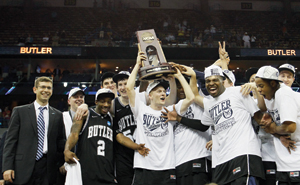
The Final Four runs for Butler and VCU also bring the opportunity for incremental revenue from online auctions, donations and subscriptions to the video service. Butler took advantage of its Final Four run last year to set up a new Web feature that allows fans to inquire about season tickets.
| 
GETTY IMAGES
The Final Four runs gave Presto incremental revenue opportunities like auctions and new subscriptions.
|
“Presto helped us set that up and it was pretty simple,” said Mike Freeman, associate AD at Butler. “We captured a lot of new names from that and it really helped us get off to a good start with season tickets and individual sales. We also saw our online gifts go way up.”
For most midmajors like VCU, though, “revenue from the website is gravy,” said Robinson, who added that traffic on vcuathletics.com last week was about 10 times higher than normal. “Branding is what we’re thinking about.
“Right now, we just want people thinking that it’s cool to be following VCU.”