A year earlier at the World Congress, expectations were high that the sports business would prove to be recession resistant, and fully able to weather economic headwinds caused by such factors as soaring oil prices, a shrinking dollar and looming inflation.However, when the 2009 World Congress of Sports convened at Miami’s Mandarin Oriental, the sports industry faced a harsh reality that would force tough decisions and a fresh look at the way business is done.
As MLS Commissioner Don Garber said during the event, “I think we’ve got to look at this as a wake-up to try to take a step back and see how we can get a better perspective on our industry.”
How goes franchise values?
 |
ALEX GORT SR.
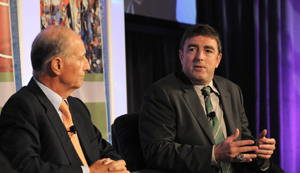
Celtics owner Wyc Grousbeck makes a point as Bruins owner Jeremy Jacobs listens.
|
Franchise prices will hold up in the recession and individual investors will be the ones who scoop up teams, Boston Celtics owner
Wyc Grousbeck said during a panel looking at the diversification of sports ownership portfolios.
“It’s swung right this minute back towards individual [investors],” Grousbeck said. “They’ve pulled it out of hedge funds [and] I think institutions are more cautious than individuals are, so for the next couple of years we’ll find individuals buying teams. In the long term, there are institutional returns to be had here.”
However, Boston Bruins owner Jeremy Jacobs disagreed, saying that the recession would affect franchise values in some markets, but he said values wouldn’t fall enough to necessitate contraction.
“I don’t think in hockey that we’re going to see a failure,” Jacobs said. “We see a lot of troubled franchises, but I don’t think we’re going to see a failure.”
That May the Phoenix Coyotes filed for bankruptcy protection.
Recession challenges sports industry
With the nation mired in a recession, panelists said the time had come to buckle down and manage the business.
“We’ve never seen anything like this and I pray that we never see anything like this again,” said AEG’s Tim Leiweke. “I don’t think we’ve seen the [full] impact yet in sports. I think these next 12 months is when we’ll see the impact because so many of our buys and so much of our business came earlier.”
 |
ALEX GORT SR.
Under Armour's Kevin Plank
|
Said Under Armour CEO
Kevin Plank, “You’re going to have some consolidation. You’re going to have some people that go away, and the ones that do survive are doing it better, different and more innovatively than anybody out there.”
Said sports researcher Rich Luker, “There is a palpable fear that [consumers] have that makes this one personal in a way other recessions have not been.”
The anxiety of the consumer was causing brands like Coca-Cola, Visa and Anheuser-Busch to rethink how they spend on sports marketing. The result was a greater emphasis on communities and activation programs that deliver value to consumers.
Coca-Cola’s Bea Perez highlighted a program that offered families hot dog discounts and soft drinks at games, courtesy of Coke. Similarly, A-B continued to invest in minor league baseball because it offered a sense of community and value for consumers.
No slowing NFL train
Sam Sussman, senior vice president, program planning and strategy at Starcom Worldwide, predicted that the “rich will get richer” in rights fees in the future, pointing to the NFL’s $1 billion deal with DirecTV as an example.
 |
GETTY IMAGES
|
“From my perspective, I’d love to see a market correction as it comes to a topic like rights agreements,” Sussman said. “If rights fees keep escalating in the way that they have in the past, one of the challenges we always have in our negotiations is making sure those costs aren’t passed down to our advertisers.”
Sussman’s prediction came true. Most recently, news broke at the start of the year that ESPN was completing a deal with the NFL to renew its rights to “Monday Night Football” for $2 billion a year.
Exploring the Twitterverse
A group of media experts said Twitter could serve sports brands and properties as a customer-service tool that offers a real-time perspective on how people react to a game, a deal or a critical decision.
 |
| Ma |
“This new Twitter-type news feed or Facebook-style profile update is the new way people are going to find information on the Web because they’re no longer going to have to Google things anymore,” said Citizen Sports co-founder
Jeff Ma. “They will just see what their friends are posting and that’s what they’re going to read and that’s what they’re going to find the most important.”