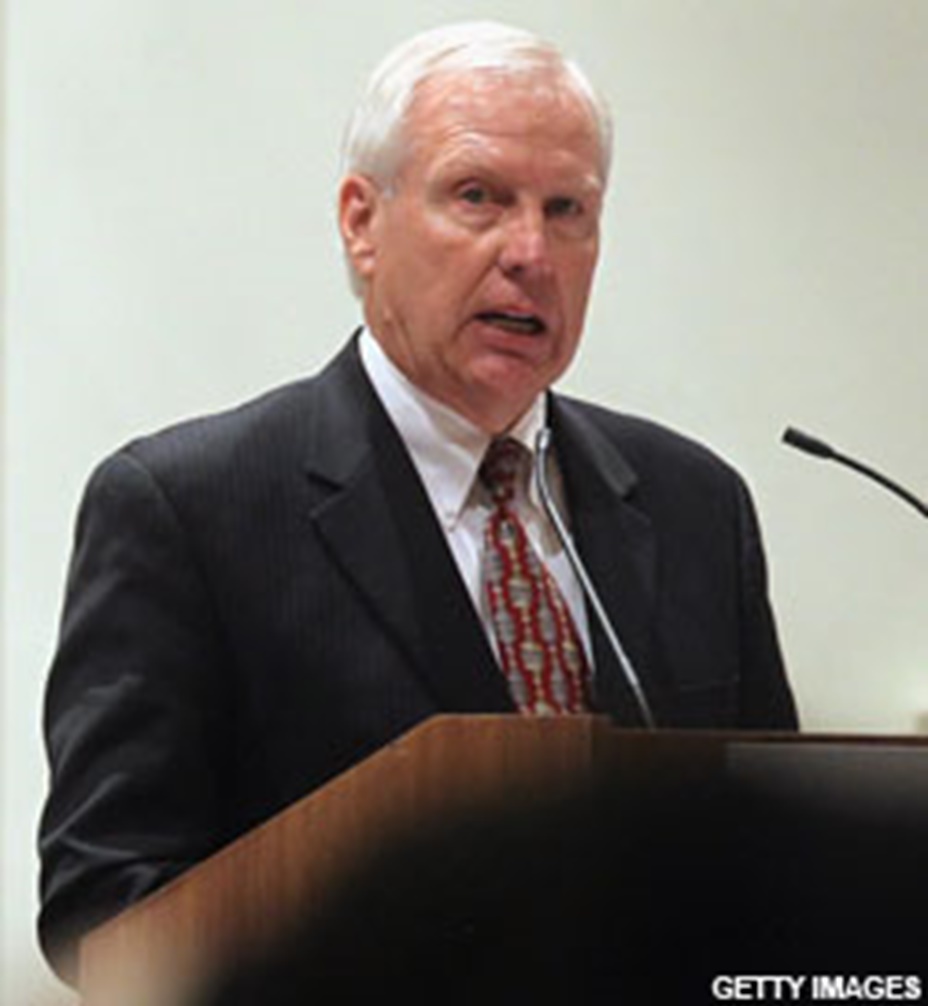
Penn State Univ. President Rodney Erickson said that had the school “not accepted the package of NCAA sanctions announced Monday, the Nittany Lions faced a historic death penalty of four years,” according to Don Van Natta Jr. of ESPN.com. NCAA President Mark Emmert “confirmed that a core group of NCAA school presidents had agreed early last week that an appropriate punishment was no Penn State football for four years.” Emmert told Erickson in a phone conversation on July 17 that a "majority of the NCAA's leadership wanted to levy the four-year penalty because of Penn State's leaders' roles in covering up the child sexual abuse of former assistant coach Jerry Sandusky.” Erickson said of his thoughts during that conversation, “Well, that's a pretty tough number to swallow. It's unprecedented. It's a blow to the gut; there's no doubt about that ... I couldn't agree to that at all." He added that almost “immediately after that conversation, intensive discussions between Penn State and the NCAA began in earnest.” Penn State lobbied for the NCAA “to take the death penalty off the table, and the NCAA described a series of other sanctions, both ‘punitive and corrective’ in nature.” Trustees said that the discussions “were so secretive that most members ... had no idea they were happening” (ESPN.com, 7/25).
MOVING FORWARD: Penn State Trustees yesterday said that they have "accepted and will move forward" with NCAA-imposed penalties. In Pennsylvania, Charles Thompson reports the board and Erickson “held a two-hour discussion” yesterday, but PSU spokesperson David La Torre said that “no votes were taken.” Trustees “objected to Erickson’s decision to sign off on the tough NCAA sanctions last weekend without briefing or seeking input from the full board.” But Erickson did “brief top leaders” and “insisted he had the authority to make the call.” The dissidents “were expected to challenge that action, arguing the board should have had a chance to review the penalties.” But by “8 p.m., the members issued a joint communique that, while stopping short of endorsing Erickson’s move, also showed no signs of a gathering revolt.” In their statement, the trustees said they found “the punitive sanctions difficult and the process with the NCAA unfortunate. But as we understand it, the alternatives were worse as confirmed by NCAA President Mark Emmert’s recent statement that Penn State was likely facing a multiyear death penalty” (Harrisburg PATRIOT-NEWS, 7/26). Erickson and “about 14 board members … were seen at the meeting” yesterday. Other members “may have participated by telephone” (CENTRE DAILY TIMES, 7/26).
PR MOVE? ESPN’s Brent Musburger said the NCAA's actions were “basically a PR move" because there was pressure on the organization "to do something." Musburger, appearing on ESPN's "PTI," said, "They should have sat back and let law enforcement, due process, take its course in this particular instance. This is not a football story. This is a story about a pedophile who happened to be a football coach. ... When they start investigating criminal activity, that is a very slippery slope for them.” More Musburger: “I think the NCAA did us a horrendous disservice by pushing football back to the front and the victims to the back. Go take a look at the sports pages today and see what the stories are all about. Out here in Los Angeles, it’s all about the running back (Silas Redd), is he coming out to play for the Trojans? … That’s not what this story is about. This story is about child abuse" (“PTI,” ESPN, 7/25).
EDITORIAL ROUNDUP: A New Orleans TIMES-PICAYUNE editorial states, “The severe NCAA sanctions on Penn State should send a clear message to all colleges across the nation that watching for the safety of young people, especially children, is the first responsibility of all athletic and university officials” (NOLA.com, 7/25). A N.Y. TIMES editorial opines the sanctions “send a potent message of censure not just to the school but to the collegiate sports establishment as a whole” (N.Y. TIMES, 7/24). An L.A. TIMES editorial states the larger purpose of the sanctions “is to tell universities across the country that there's a considerable price to pay for letting their mission become subservient to their athletics programs.” Yet the NCAA “may not be the right organization to deliver that message, and the broader problem epitomized by the Penn State scandal can't be solved by imposing temporary punishments on a single institution” (L.A. TIMES, 7/24). A CHARLOTTE OBSERVER editorial writes under the header, “NCAA Sends Penn State A Message: Put Welfare Of Young People First” (CHARLOTTE OBSERVER, 7/24). A USA TODAY editorial states as “fitting as the punishment is, this single action shouldn’t be confused with tough leadership from the NCAA.” Now the question is “whether the NCAA and the presidents truly have the courage to promote the sort of cultural change that’s so badly needed in big-time college sports” (USA TODAY, 7/24).